Showing posts with label poverty. Show all posts

Saturday, 24 March 2012

Learning Lessons


Recovering from a surprise bug and unable to do any more than read, (no great penance, needless to say), I found Liam O'Flaherty's 'Famine', which was on my shelves for some time and I always meant to read. I read it in two days and must tell you, it is an amazing, a stunning, a riveting piece of work. There are so many parts of it I would like to tell you about, but they are too many, and I really don't want to spoil the discovery for anyone who gives it a go. I urge anyone who wants a meaningful novel to read, get this book. It is a story told against the background of the Irish Famine, also known as The Great Hunger. The Famine was always given a capital letter when written about, and with reason, for it was an event written into all our psyches, albeit some are unaware of it. I would go so far as to say that it may well be at the back of the country's troubles today, for the way the country behaved during the so-called 'boom' which ended catastrophically in 2008 was definitely not the way a population unscarred by massive want or hunger would behave.

Critics who were quoted on the back cover of the book said that Mary was the heroine, and indeed she was, but underneath it all, Brian, her father-in-law, is the most memorable character. All the characters, however, are well-drawn and rounded figures. It is a horror story all the greater because it describes real times in the life of this small island, from which everyone suffered, at the very least psychologically. Most of the suffering though was physical also, living skeletons walked the roads, eating whatever the countryside provided; those who could got away to England or America.

I never can understand the wide spaces of road edges and the fields lying empty of cultivation or stock which one sees when travelling around the Irish countryside. And not too far from our local town, there are paddocks of ragwort seeding themselves everywhere. Years ago there were warning notices in the post office against ragwort and its dangers for horses and other animals. Nowadays, no-one seems to care. Surely with a history such as ours, empty or poisonous fields cry out to heaven. There is no reason for us not to be totally self-sufficient as far as food is concerned with the land and water we have. As global warming, for whatever reason, continues, others will come and show us how to use our fields.

This book about the Famine was all the more real for me because I've been digging into family history recently, and learned that a great great grandmother who died of post-famine fever was carried to Glasnevin cemetery in Dublin on a wheelbarrow by her husband for burial, because no workers would risk going near the body. Another great great grandfather who was a teacher died in Co. Carlow at the time, with his wife and two young children. Everyone was affected in one way or another. This book was written within ninety years of the horror, in 1937, and the copy I have is a paperback edition dated 1979 and published by Wolfhound Press.

Liam O'Flaherty wrote among other novels one called 'The Informer' which was turned into a film by John Ford, who was actually a cousin of his. I would think that 'Famine' would make an awe-inspiring film too, giving plenty of work to extras. The most momentous parts of the book are very visual:
What more can I say! If you can at all, do read this book.
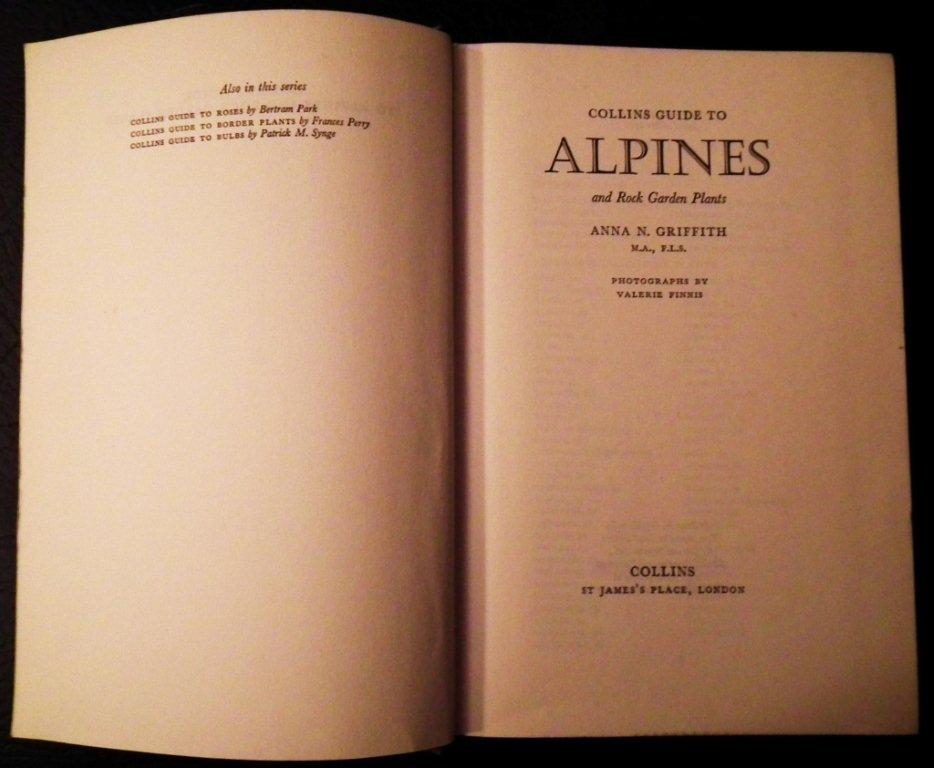
Lots of people say they would love to garden, but they don't have time, or a big enough garden, or the know-how. Well, the latter is easily acquired from books, and also now from the world wide web, obviously. If you don't feel you have the space, and you are short of time because you must work for your bread as well as run a home and pay for the baby minder, (I'm not going to talk about that weird state of affairs just now), and you think a houseplant or two would bring dust and pests into your house (not necessarily the case but it is a widely-held view), get yourself a little sink or fish box, or make a concrete tub, stand it at your back door, fill it with good well-drained soil and grit, and buy some tiny plants. 'Collins Guide to Alpines' , by Anna N. Griffith, published by Collins London in 1972 is the type of book you need now. It gives the names of rock plants which are not in the main hard to find, tells you the type of soil they like to live in, whether they mind getting too wet or not, and when they will flower. When you find these tiny plants you will fall in love with them. The first year you garden this way, you will buy many so-called tiny plants which will take off and become giants; blame the nursery and move them to a border or give them away, and start again. Research and experience will teach you the names of the plants which will stay small. Seed sellers such as www.chilternseeds.co.uk will have seeds of many teeny plants which can be sown outside in your little garden. Or you may want to have another box just for seedlings. Eventually, you may want another sink or trough...but you will not have to walk far to tend your garden, and the plants will not have to be cossetted. You have a whole new interest in life as long as you can keep your plants out of reach of the family dog which was supposed to be the size of a Yorkshire terrier but is daily showing more resemblance to a St. Bernard. You may have to dissuade the family cat from sunning herself on the more cushiony plants, but a few sprinkles of water should do the trick. The library should have books on sink and trough gardening; rock gardening in the title is not always a good bet, as some people have monstrous sized rock gardens with five foot shrubs in them and rocks like the foothills of mountains. Books on trough gardening, though, unmistakeably deal with tiny plants which can be relied upon to stay within the stated limits. And if you ever want to garden in a larger way, all you learn in taking care of your miniature plants will easily transfer to their bigger brethern. Go for it!

'Teach Yourself To Learn A Language' is one of the famous Teach Yourself books, in this case written by P.J.T. Glendening, and published by The English Universities Press Ltd., London in 1963. Inside you will find sensible instructions on what you must do before you proceed to study your language of choice. It gives examples of the type of survey of a language which should be made before you start. The languages surveyed for this purpose are Arabic, Chinese, French, German, Hindustani, Italian, Japanese, Malay, Portuguese, Russian and Spanish. I have found it a wonderful book, which inspires you with confidence in your ability to learn a language.

Irish people have the idea that they are bad at languages. Partly to blame for this is the poor teaching of their own native tongue, well, nowadays, their second native tongue, for we are almost all accomplished speakers of our first language, Hiberno-English. I recall a mature student in UCD telling me that she had just discovered that Irish had genders, Masculine and Feminine, the existence of which she was aware in other languages such as French, but no-one had ever mentioned it concerning Irish. I think that is a sin. What kind of language teaching can lead to that ignorance and confusion? There always seems to have been a school of thought in Ireland that we can learn the Irish language in a kind of osmosis because it is lodged somewhere in our Irish brains, just waiting to come out. But the teaching of languages in Ireland generally is a disgrace. The first thing which should be taught in schools is linguistics. I recall two first-year students in UCD whose first tongues were German and Spanish respectively, who had studied linguistics from the age of seven in Germany and Spain. They got Firsts in their first year university courses, while the Irish struggled with this peculiar discipline. Of course they triumphed later in their further language studies, one in Arabic and Hebrew, the other in English and Portuguese. The former was fluent also in English, Norwegian and Italian as well as of course in her native German.

You don't need me to tell you that we now have a high percentage of young people unemployed. The agencies which are delivering re-education such as Information Technology to these young people ignore the acquisition of foreign languages totally. Yet look on any job recruitment site online and key in that you can speak a language such as German, Italian, Russian and so forth, and you will be inundated with job opportunities just waiting to be filled. The fact that many require a degree should be no problem to our highly-educated populace. Try, for example, http://ie.jobrapido.com/ and put any language in the search box, and give your e-mail address. Day after day you will receive notice of jobs in Dublin or countrywide which are waiting to be filled by anyone who can speak just one foreign tongue. Any government worth its salt should be offering retraining in languages to the young unemployed, even if they only hope to export them to Europe, of which we are supposed to be so much a part. Pshaw! That's what I say. It's time to get real here! You too can learn a language. It's a set of rules which you learn to follow, and a vocabulary which you will acquire if you dedicate yourself to it. Every day people learn new words; the fact that these new words are not English, should make no difference. You can do it!

Saturday, 4 February 2012

Spoken Lives


Listen to people chatting in a café, the noise of cups, the gasp of a coffee machine making a background rhythm to the rise and fall of the narrative; the gentle murmurs of verbal correspondence soothe and lull, without the necessity of personal input. That for me is the beauty of books in which people tell their personal stories; reading them is like listening at a distance; I'm not involved but am captivated by the language, the naturalness of ordinary people speaking out their lives.

All the better if there are photographs of the speakers., as is the case in two of the books I am writing about tonight. Seeing the faces of the speakers adds depth to the experience.

“Forgotten Voices Of The Great War” is by Max Arthur, in association with the Imperial War Museum, published by Ebury Press London in 2003. It was put together from tape recordings of veterans of the First World War from both sides, describing how they were recruited, their training and their experiences on the Western Front and in the Gallipoli campaign. We have read of these horrendous events many times before; they never fail to shock – the waste, the total destruction, but above all the terrible innocence and ignorance of the recruits of all social groupings in believing that the war would last at best a month or so, at worst, maybe a year. Most signed up at the recruiting centres, but some British were actually recruited at the music halls; others were moved to enlist by the finger pointing poster of Kitchener. Germans described the elation of arriving at the Front in trains and being greeted with adulation and flowers; what shocked me most were the women. Mothers wept with pride as their sons marched away; young women, who didn't have to go to the front themselves, handed out white feathers to those they saw in civilian clothing (even soldiers on leave).

Rifleman Norman Demuth of the London Rifle Brigade says:

“As well as being given white feathers, there was another method of approach. You would see a girl come towards you with a delightful smile all over her face and you would think to yourself, 'My word this is somebody who knows me.' When she got to about five or six paces from you she would suddenly freeze up and walk past you with a look of utter contempt and scorn as if she could have spat. That was far more hurtful than a while feather – it made you curl up completely and there was no replying because she had walked on.”

Now when I read about the women left without men after those war years, I don't feel the same sympathy, even though no doubt not all women were like that. Later, with the draft, it was different....and I know they were different times, but one hopes that people would never be so easily led again. Then into the mind come images of body bags flown in from Iraq....Afghanistan...whence next?

Heinrich Beutow was a German schoolboy in 1914. “My memories are those of a child of course. I was in a small German garrison town in 1914 and I remember very well the tremendous enthusiasm. ....I shall never forget the day when they marched out to the trains. All the soldiers were decorated with flowers, there was no gun which did not show a flower. Even the horses I think were decorated. And of course all the people followed them. Bands playing, flags flying, a terrific sort of overwhelming conviction that Germany now would go into war and win it very quickly.”


Kitty Eckersley, a mill worker in Clayton, near Manchester, described how her young husband joined up: They went to a show at the Palace Theatre: “...when we got there, everything was lovely. Vesta Tilley was on stage. She was beautifully dressed in a lovely gown of either silver or gold. But what we didn't know until we got there was that also on stage were Army officers with tables all set out for recruiting. She introduced those songs, 'We Don't Want To Lose You, But We Think You Ought To Go' and 'Rule Britannia', and all those kind of things. Then she came off the stage and walked all round the audience – up and down, either sides, down the middle – and the young men were getting up and following her. .....I don't quite know what happened but she put her hand on my husband's shoulder – he was on the end seat – and as the men were all following her, he got up and followed her too.” Sounds like mass hypnotism, doesn't it? Followed by what we now know was mass murder.

In “Catching Both Sides of the Wind”, by Anita Jackson, five black pastors in Britain in 1982 speak about their lives. This book was published in.1985 by the British Council of Churches, London, and it turned up on the shelves of the recycling centre in lovely condition. Once again, as in any conversation, some things stick out. It's hard to know what is the truth. I found one of the pastors more frank than the rest. The others all seemed to be trying to convey how much less permissive a society it was in the West Indies than in Britain when they arrived during the 1950s.. In their former homelands, according to a couple of the pastors, the church educated and the people looked up to them, and were quite conservative in their behaviour. Reverend Robinson Milwood, a Methodist Minister in London says

"....let me go back and make clearer what I mean by black values. A black value in family life is that the child leaves his family home only for his own home......The permissiveness in Western culture now means that little value is placed on respect for elders in this country, and this has been the main reason for the gap between the black young and the parent generation....There is a clear-cut hiatus between black adults and youngsters in this country,.....”

Pastor Ira Brooks, a Pentecostal Minister, says:

"In the West Indies there's no such thing as a child being born out of wedlock being unlawful. It was common for a man to cohabit with a woman, and she was his wife. And people didn't see anything wrong with that until different standards made it a disgrace to live like that.” He went on to say that people of his generation in Britain were often fearful that their children would find out what life in the West Indies had really been like.

What is the truth? No doubt, as usual, it is somewhere in between the two poles. As with information gleaned from café conversations, who knows? Sometimes we tell it as we want it to be. Appearances seemed to matter a lot. A brother of mine worked in a factory in London as a young man, and laughed as he told me about some of his fellow West Indian workers, who arrived in suits and with briefcases containing only their sandwiches, changed into working clothes, then did the same in reverse at going-home time. It was important to them that neighbours and relatives believed they were office workers for prestige purposes. In the book,there are pretty bleak stories about the way even black pastors were treated. The police, all the pastors were agreed, were not helpful to the black man. Of course they were talking in the 1980s about thirty years earlier, when they had come to Britain. However, the feeling seemed to be that in the 1980s not much had changed. Sometimes it seems from news reports on TV even now that things haven't changed all that much. Most of the pastors hoped to go home eventually, although as one said, their children being British was a kind of a trap for them, because the children had no desire to go back to their parents' homeland. Landlords exploited them, what is new about that tale? Furnished flats had smelly beds bought secondhand, anything was good enough for black tenants. The Irish shared that experience. Thank goodness for modern tenancy laws. But these are the things you don't read about in history books, and yet they are the stories of people, and surely are more important than events. It seems to me that most history is actually the history of politics and warfare, with anything else incidental. I myself did not realise that oral histories of ordinary people's lives were something fairly recent. Now that I think about it, of course it was the advent of the tape recorder that brought these stories to the fore.

“Dublin Street Life & Lore – An Oral History” was written by Kevin C. Kearns, and published in 1991 by Glendale Publishing Ltd., Dun Laoghaire, Ireland., and I found it at a book sale some years ago. It's full of stories told by elderly people who lived and worked in the city of Dublin from the beginning of the last century. Here are the voices of lamplighters, dockers, postmen, chimney sweeps, pawnbrokers, street dealers, newspaper boys, jarveys, even fortune tellers. Some of the reminiscences are surprising.  This is Lizzy Byrne, Moore Street Dealer, at the time of the book aged 82, talking about the Easter Rising:

“..I remember the Rebellion...1916. I was playing on Henry Street when that happened, beside the Post Office. We didn't know what it was, we were too young. We heard the shouting and people got all excited. They were afraid for their life! We locked ourselves up for nearly a week. You'd be afraid to come out. It was only fighting between two certain crowds, you know. But we let them go on with it and it only lasted for about a week.” That is quite a casual description of the Rising that led to the foundation of the new Irish state.

There was one particularly sad memory, told by Willie Murphy, a docker 79 years old when he speaks in the book. He is describing the 'readings' dockers had to endure every day to have a chance of work. The stevedore stood calling out the names of those who would have work that day, calling his own family and relatives first, and this was the 'reading':

“At readings men had it in their minds that there was something at home wanting on that table. And if they didn't get a job that just put them down in the depths. Heartbreaking. It's true.....you could see the tears in their eyes. And they'd run from one read to another cause there'd be readings for other ships. Like some of them we'd call cross-country runners cause they could run that fast to get to another read. As soon as one reading was over you could see them run...” It doesn't bear thinking about, what it must have been like, how soul-destroying, how crushing on self-esteem. No matter what things are like now in Ireland, they are better than that. Also let's not forget that they are still like that in other countries, something we shouldn't forget when immigrants come to us in hopes of a better life.

There was humour too. This is Mickey Sheridan, a 68 year old Jarvey in 1991, talking about another old Jarvey:

“,,,And one old chap, Barney Doherty., had a big old heavy horse under the cab. It should have been under a plough and not under a cab. He wasn't a smart-going horse. So the fare he had in the cab put his head out and says, “hey, jarvey, will you put on the lashes? I can walk quicker!”. And he'd three articles with him. So Barney opened the door and says, “if you can walk quicker there's the path..and there's your three articles of luggage to keep you from breaking into a gallop!” Oh, they were characters.”

I lost a book friend two days ago, the second in a year. He's been a friend for a long time, but not what you could call a really close, see-every-day kind of friend. When we were in touch, it was usually to do with books, and we could talk about them for hours. We would ring each other if we heard of a book sale; he had a friend who ran a bookshop in Dublin, and if I needed a book I would ring him and he would ring his friend to see if he could track it down. One time I was looking for a really obscure title called “The Confessions of Zeno”, an English translation of Italo Svevo's “La Coscienza di Zeno”. This was in the days before you just looked it up on the computer and bought it online. I had searched and phoned everywhere without success; a few minutes after I rang him, he got back to me in great glee saying that incredibly his friend in the bookshop had actually had that very book in his hands when he called, and in the afternoon he brought it to my house still elated over the coincidence. A major part of Svevo's story is Zeno's efforts to give up smoking. My friend shared that problem with Zeno. In November he told me he was dying and the day before yesterday he did.

In life he was a soldier, and later a fireman. One story he loved to tell was about how, going to the fire station one morning in his uniform and halted at traffic lights, he spotted a car going on fire. Leaping out of the car he grabbed a fire extinguisher and ran over and put the fire out. The astonished driver said to him “My God, you fellows certainly are quick”.   He was funny and clever, a wonderful raconteur and unpublished writer; but above all, he loved books. If there are celestial libraries, I will know where to find my two friends when I make that journey myself. Does that sound strange? I can't help noticing that nature has her reasons, for everything . After we have left our teens and twenties, we are not so fast on our feet any more; younger people beat us at most types of active sports. Even if we are very fit, we were probably fitter when we were younger. It is the same with all animals – the older become slower. There is no longer a need for speed. If this is not true of all people, it certainly is of most. Also at a certain age, we stop reproducing, especially if we are women. Once again, this is a physical part of our lives declining because we have fulfilled that part of our destiny. But right up to the moment we die, we can study, read, absorb information of all sorts. Is this some shortsightedness on the part of nature? I think not. And so let us all, eventually, adjourn to the Great Library.