Showing posts with label plants. Show all posts

Saturday, 11 August 2012

An August Writer and Other Subjects

'Mangan' by John D. Sheridan, published in 1957 by the Talbot Press Ltd. Dublin and Gerald Duckworth & Co. Ltd. London, is a little paperback on the life of James Clarence Mangan, the Irish poet, born in May 1803, died June 1849. This book is apparently in a series called 'Noted Irish Lives' for so it says on the cover. I have no idea of the titles of the other books in the series, and not a hint is given anywhere in this little volume. It was rescued from the recycling centre and truly is in terrible condition. Still, I had to read it first, it seemed such a waste of all the endeavour that goes into the making of a book to simply leave it on the shelf to go its way to ignominy. I have never seen so much foxing on a book, so many of those brown spots that tell the sad story of a book's life in some damp and dreary spot, under the eaves or in the basement or in an old, hardly-ever opened cupboard of some probably musty, stale-smelling house. Someone had thought enough of it to sellotape the spine where the front cover was hanging off.
The author gives credit for many of the facts in his little work to a D.J. O'Donoghue, “and to that writer's very full Life I am, of necessity, much indebted.”

John D. Sheridan was himself a well-known Irish writer, mostly of essays which are full of wit and interest about his life and encounters. As a child I remember them in the newspapers, and collections were published which I often brought home from the public library.

Mangan had a peculiar and somewhat morbid personality, it seems.  I would also call him a typical oldest son, though, having experience of the breed both in my own siblings and among my offspring. Add to that that he was a poet, who wrote several well-known poems, among them two of the most famous Irish poems ever, “My Dark Rosaleen” and “Oh Woman of Three Cows”, the latter a translation from the Irish, which Mangan had diligently taught himself. He was mad about languages and is reputed to have bluffed his way through a lot of them, giving many translations from, John D. writes “the Turkish, Arabic, Persian, Welsh, Coptic, Danish, French, Serbian and Spanish, and on one occasion he informed the editor (of The Dublin University Magazine) that he could supply him with Hindoo poetry if he wanted it.” The translations, by what I read in this book, were often more invented than true to the originals. However, in his day very few of his readers knew the difference, and to his credit, some of his fancied translations were apparently pretty good.

In his unwrinkled prose, John D. Sheridan's describes him as wearing strange baggy trousers, green spectacles and often a fez, summoning up a unique character marching around the Dublin of his time. In his neat, unwrinkled prose, John D. quotes a description of Mangan by a contemporary, John Savage:

“He is of middle height, and glides rather than walks. A dark, threadbare coat, buttoned up to the throat, sheathes his attenuated body. His eye is lustrously mild and beautifully blue, and his silver-white locks surround, like a tender halo, the once beautiful and now pale and intellectual face.”

His friend, Father Meehan, mentioned frequently in the book, described him also:

“And the dress of this spectral-looking man was singularly remarkable, taken down at haphazard from some peg in an old clothes shop – a baggy pantaloon that was never intended for him, a short coat closely buttoned, a blue cloth cloak still shorter, and tucked tightly to his person. The hat was in keeping with this habiliment, broad-leafed and steeple-shaped,”......”Occasionally he substituted for this headgear a soldier's fatigue cap, and he never appeared abroad without a large malformed umbrella which, when partly covered by the cloak, might have been mistaken for a Scotch bag-pipe.” It would appear he wore several types of individualistic headgear.

I got so much from this little book. It really brought home to me what Dublin was like in those days, when my own ancestors walked the same streets as James Clarence Mangan. Who knows, maybe my great-grandfather, a printer and stationer at the time in Dublin, may have actually known him!

There are so many interesting little pieces in the work – the story of how Mangan was evicted from a lodging consisting of a hay-loft, because he refused to agree not to light a candle in it in order to read. Two or three times he is hospitalised, and it is surprising to read of the clean sheets and orderly wards at a time before the middle of the 19th century – when we are hard-pressed to provide similar refuge for our sick in this day and age. Indeed, we are told that when he was brought to the Meath Hospital, where he died of cholera a week later, a surgeon who knew his fame provided him with writing materials which he duly used despite the seriousness of his condition; sadly, a nurse who had been scolded for her untidy beds disposed of them immediately on his death. No contract cleaners in those days.

Here is the link to a site I found where the poems mentioned above, and another, 'Siberia' are printed:

http://www.irishcultureandcustoms.com/Poetry/Mangan.html Have a look and see what you think of them.


I found two little Russian grammars a few years ago in a bookshop. They are Vol. 1 and 2 of 'Russian Grammar Simplified' which is in the 'Hugo's Simplified System' published by Hugo's Language Institute, London, and describes itself as “An Easy & Rapid Self-Instructor.” I can't for the life of me find a date anywhere on the books, but I would make a guess at sometime in the 1950s. I have plodded slowly through the first volume, which consists of 18 lessons, and am now revising at Lesson 11. It says something for this book that I have stuck it out. I understand everything I have done so far and am determined to endure to the end. I'm very old-fashioned, probably on account of being quite old, and when languages were taught in school years ago, grammar was very important. It's like going into a forest and finding your way by getting to know the trees along the route. The trees get more familiar the more often you take the route. At first you are totally lost, of course, but it gets easier. More modern language books plunge straight into conversation, but for me anyway, there is nothing in that to hold on to, nothing to tell you where you are. The person who owned these little books before me obviously used the first volume a lot too, and doesn't seem to have got to the second one, which is clean and new-looking while the first was a bit worn. Now the first is even tattered, being a paperback and travelling everywhere with me in my little satchel.
Why am I learning Russian? Well, I made a few attempts before, starting at age eighteen when I found a book called 'Russian Through Reading' in our local library. Full of teenage angst, I lolled around reading Dostoevsky, Turgenev and Tolstoy and it seemed a natural step to have a go at learning Russian. There were many abandoned attempts since then, but now I think I am making some progress. Also, recently to my delight I acquired a beautiful new daughter-in-law who is a native Russian speaker, so there is even more incentive to learn. Of course, she speaks perfect English too and is an English teacher, but I think it would be nice to know her native tongue even a little before we meet
I heartily recommend these Hugo language books. I also have the Italian set, found with the Russian one at a local secondhand bookshop which departed with the 'boom'. They are still obtainable online from book companies, I see. They are the forerunners to the Hugo Learn a Language in Three Months series, and I prefer them at least for beginning. Everyone has his or her own method, I expect.

Kenneth Lemmon wrote 'Winter Gardens', an old Mini-Book by Corgi, published in 1970 by Transworld Publishers Ltd. London. It is a little paperback, with a picture of crocuses appearing through melting snow on the cover. I have this book a long time and have always loved it I think I bought it new, and it pops up every now and then on the shelves when I am looking for something else, you know the way. It consists of six chapters and two appendices, giving details of all the plants that will grow happily in our gardens despite the cold. If even a small part of a garden were separated from the rest a lovely little winter garden could be made that would cheer the darker months. Our own garden is large and we do have winter-flowering plants in it, but I can imagine how well they would look if all were growing close together where they could be seen in a block. I think if I only had a little room-sized patch, as many have these days, I would fill it with winter plants, and in the summer grow annual climbers and other temporary plants all over them so I would enjoy the two seasons to their fullest. A couple of spring-flowering shrubs and autumn-flowering plants, and the show would be complete, no matter what the weather. Placed near windows, the view could be admired cosily from inside if it were not desirable to venture out.


Monday, 11 June 2012

Joyous June Reads


The sun is beaming down and it's like another country here. Today's books go with the happy mood, being light-hearted and interesting, besides not being in the usual run of reads.

Even if you have never had much interest in making music, you could well enjoy 'Making and Playing Bamboo Pipes' by Margaret Galloway. The author's name even has the ring of the piper about it somehow. It was published by Dryad Press of Leicester, UK, in 1958. Dryad used to produce leaflets on every type of handicraft, and I well remember carrying bound copies of them home from the library with glee; any handicraft you can think of was described in these volumes; if you never made anything yourself out of them, they were a sheer pleasure to read. This book is a reject from the same local library. I don't think modern handicraft books come even close to the variety so simply and yet comprehensively described in Dryad's books, This particular work begins with the” Directions for Making a Simple Treble Pipe” and ends with an account of the Pipers' Guild and how to join it. The instructions embrace every aspect of the pipes, including how to polish them and most importantly how to play them.There are tunes to test the pitch of the pipes too, and how to amend errors; everything is considered. Definitely this is a joy of a book.

The next book asks “What are the Seven Wonders of the World?” A church sale find, it is written by Peter D'Epiro and Mary Desmond Pinkowish, and springs from an unusual idea: starting with a section entitled 'Three', it asks “Who were the three sons of Adam and Eve?”, then “ Who were the three gods of the Hindu Trinity (the Trimurti)?” It carries on through various numbers up to and including twenty-four. One, Two, Eleven, Fourteen, Sixteen, Seventeen, are conspicuous by their absence, as well as from nineteen to twenty-three inclusive; it is intriguing to wonder why these numbers have been of little significance in the life of humanity. It deals with, for example, the six “major European invasions of Russia since the time of Peter the Great”, the 7 Deadly Sins, the 9 Lyric Poets of Ancient Greece, the 12 Tribes of Israel, “the unoffical Homeric titles of the 18 chapters of James Joyce's 'Ulysses' “ I think you get the picture now. This is a paperbook published by Metro Books, London, in 1999, and is certainly an interesting approach to a lot of historic and pseudo-historic questions.

'Too Good to Be True – The Colossal Book of Urban Legends' is another fascinating read. You know all those weird stories you read about on computer forums and in mass-circulated emails - this book gathers them all together and debunks them.It is published by W.W.Norton & Company, New York – London, 2001. It is a paperback in fine condition and came from a school sale. The author explains that the urban legend is the sort of story which you are told is totally true because the teller knows the person it happened to for sure, but then it turns out when you ask them again that it was actually a cousin of a friend's neighbours uncle to whom it happened but they swear it is true! One of these urban legends is about “The Baby on the Roof”:

“Did you hear about this couple driving through Southern Utah? They were on their way to California, and they went to change drivers and the wife took the baby out of the car and put him on the roof of the car. Then they both switched sides and got back into the car. She just assumed that the husband had put the baby back in, but he hadn't even seen it. They drove off, and the baby slid off, but he was OK because he was in a plastic infant seat. About two hours later they realised that they forgot the baby. So they drove back, and someone had stopped for the baby, and the baby was OK"
.The author, Jan Harold Brunvand, says that he has on file news stories or first-hand accounts dating from 1975 to 1993 of fourteen such incidents occurring either in the US or Germany with varying outcomes for the infant. What interests me is that this urban legend was travelling around therefore before the internet got going. What does puzzle me, though, is why it was necessary to take the baby out of the car at all, just to change drivers. Anyway, this book is full of stories, good to read for themselves even before you consider them as urban legends, with titles such as: “The Killer in the Back Seat”, “A Bug in the Ear”, and “The Devil in the Disco”. My own mother had a version of that one, which told of a girl meeting the devil in a local dancehall, allowing him to leave her home and then just in time spotting his cloven hoof; that was not today or yesterday. Obviously these stories have been doing the rounds for some time. Jan Harold Brunvand looks on them as a type of folklore, which of course they are, and they have that most vital characteristic of folklore, staying power.

'Where Joy Shines Through' is a lovely little hardback, and I brought it home from the recycling centre because I love drawings of any kind; this is full of illustrations of all sorts, from the cartoon type to the representational – plants, animals, human beings and landscapes as seen by artists with just one thing in common, that is, they are disabled to some degree, and these illustrations have been created with the help of mouths or feet.They are really done, however, with the hearts and minds of wonderfully talented artists. Accompanying the pictures are aphorisms such as “Thrift is most admired by an heir!!!” which do not necessarily have any connection to them, which is perhaps a little quirk of the book, not anything to spoil it, but slightly puzzling. This book was published by the Disabled Artists Association of Cork (Ireland) in 1986, so someone treasured it for a good few years before parting with it.

I could well be accused of having cornered the market in second-hand house plant books, by the amount I have collected over the years. I make no apology for this – growing and reading about house plants have cheered many a day in my life. One of the Reader's Digest Successful Gardening series, 'The Indoor Garden' , published in 1994, is a winner of a book I came across at a car boot sale. What I really like about this book is the way it categorises the plants according to the growing conditions they prefer, such as “Plants for humid air”, “Plants for shady areas” and so forth. A lot of people dislike house plants because they see the same type over and over again in their local supermarket. But there are many many more types of plant for growing at home, than will be encountered in the supermarket or even in the gardening store. Since the arrival of the computer in all our lives, it has become easy to meet other enthusiasts and to trade with them; in this way I have discovered the most intriguing plants, some of which you will never see for sale, except perhaps at a school or church 'bring & buy' sale, or of course at those run by gardening clubs. For instance, Ceropegia woodii is a lovely little succulent plant, also known as Rosary Vine or even more aptly, String of Hearts, because the leaves are shaped like little silver and green hearts and strung out along their trails; this plant is almost never seen in ordinary shops although it is much easier to grow than most you will see while you're doing your weekly shop. One reason for the amount of quite difficult house plants commonly to be found on sale, in my opinion, is that if all our indoor plants thrived, we would not need to come back for more as often as big business would like. This morning, I received in a trade a variegated form of the Ceropegia woodii, with leaves of silver bordered with white, a most appealing and pretty plant. I wager I will have a better chance of keeping this happy than the myriad of languishing indoor plants from the supermarket displays, which have already experienced too much heat or too much cold, draughts, over and underwatering, and perhaps even rough handling before they got to the shelves in the local Tesco or Woodies. When you think that these are living creatures, a vital part of our environment, you would think that they deserve a little more dignity than they commonly receive.

"Frankly Speaking' came from the recycling shelf, and is a book of humourous stories told by ministers from most of the Irish churches, and they are told with a certain winning innocence. The editor, Frank Sellar, is a minister of Adelaide Road Donore Presbyterian Church since 1990, we are told, although I'm not sure if that holds true today. It was published in aid of 'The Road Ahead Project' – a “major million pound redevelopment project which will involve constructing a purpose-built complex behind the current listed facade. This will enable the church to continue to provide a range of programmes for people who are unemployed, parents and children from all backgrounds in Dublin City Centre.” I don't know if the project ever got off the ground, but hopefully it did and succeeded in all its aims. Here is one of the stories, contributed by Rev. BHS. Liddell, Former Senior Minister, 1st Coleraine Presbyterian Church:

“80. An Invitation to Prayer

During a visit to an old farmer I asked Robert if I could “Keep Worship”. “Aye” he replied “but wait till I call in James”. James was the farmhand and was working in the yard. Robert went over to the kitchen window, knocked on it and gestured to James to come in. Then, turning to me, he said, “James will get a 'quare gunk'. He thinks he's being called in for his supper!”

“9. Don't Noah” was submitted by Rev. Joe Mooney, Retired, Grange Presbyterian Church.

“The minister had been talking to the children about Noah and the Ark. After Church, one little boy asked his grandad, 'Granda, were you in the Ark?' 'No, son, I wasn't' replied Granda. “Then”, asked the boy, “how come you weren't drowned?"

 So, it is June, the days are long and bright, we even had sunshine today. Keep your hearts up. Mother Ireland is managing to smile a little.


Saturday, 28 April 2012

The Light Side Of Life

The pull to be in the garden is so strong now that spring is really here that it's hard to find time to write my book blog. However,the rain of the last few days gave me time to hunt out the next lot of books. Although sitting down to read them was not in the plan, I had forgotten how readable and inspiring was “My Rock Garden”, a book which a friend found at a sale years ago and dropped in to me on her way home, one of those kindnesses that are never forgotten for their spontaneous generosity. Reginald Farrer wrote this book, and my copy is from The Garden Book Club, London 1942, when a lot of gardeners had other things on their mind. No doubt it cheered many a person who was wondering if he would ever enjoy growing flowers again.

I had a little Brownie 127 camera when I was very young, and when the children were growing up we had a little Halina. But I was never really a photographer, for lack of both time and money. Things changed in the years since 2000. Digital cameras arrived, and at the same time, people began throwing out their old film cameras as well as film, often out-of-date; many found their way to charity shops and I brought them home. When we got our first computer, the bundle that came with it included a Kodak digital camera. It had a viewfinder but no lcd screen and I hadn't a clue how to use it. Around the same time I found a Halina 3000 in the Oxfam charity shop attached to the recycling centre, and at a library sale the next day I found 'The Amateur Photographer Handbook', published by Hamlyn in 1987. It's a very thick, smallish-sized hardback, with lots of text and drawn illustrations, as well as, naturally enough, photographs, although they are not many for the size of the book. Since then I have never looked back. I found that the way to learn how to take pictures is a combination of reading and doing, and for the active part of the adventure, the Halina 3000 is a wonderful camera. It has an uncoupled light meter on top with a little pointer to a number, and you set the speed and aperture so that the same number appears in a little box on the camera, then you take your photo. If you change the shutter speed, for instance to take a faster-moving object, you will have to change the aperture setting in order to get the same number again in the box, and this is how you suddenly realise what it's all about. Of course, you may have known all that already, but I didn't. Then, once I started to read about light meters, shutter speeds and apertures, everything became clear. If you start your picture-taking life with a modern digital point-and-shoot it is a different learning experience, but ultimately, both film and digital cameras work on the same principles. More sophisticated cameras, both digital and film, have coupled light meters, and the camera chooses the shutter speed and aperture, but with one of those I wouldn't have learnt the function of the camera settings.

I bought the next photography book, 'The Instant Picture Camera Handbook' by Michael Langford, published by Alfred A. Knopf, New York, 1980, to go with an instant camera I found in the same Oxfam shop. Although one might think that digital photography is 'instant photography', this is just not true. When I take pictures with a digital camera they lie a long time on the computer, and I hardly ever feel moved enough to print them. My Fujifilm Instax camera gives me the print immediately, without the need for printer or ink. Granted there is the cost of the film but you can get good deals online. Polaroid film disappeared around 2008 except in hugely expensive buy-it-nows on E-Bay, but there is a new company called the Impossible Project making it now for the old Polaroid cameras, and Fujifilm for many years have been making peel-apart type film FP100C and the like for the old Polaroid Land cameras. I however find Fujifilm Instax is all I need. The Impossible Project film is very expensive, also it is not all that stable yet, so results are often unpredictable. If you are interested in just taking out a camera for fun, I recommend the Instax range of cameras. Also remember that Instax film won't fit Polaroid cameras nor will the new Polaroid type film fit the Instax cameras. Go to www.flickr.com and put Instax in the search box and you will get an idea of how good these photos can be.

There are many many books on photography of all types, film, instant film and digital. I have found that the fancier the book and the more packed with photos it is, the less you can learn from it, at least at the very beginning. Just learn what shutter speeds are about, why you might need to change the aperture, how to take pictures in different lighting conditions, things like that, and you will soon have it all. On photography forums you will find all kinds of lofty conversations about lenses and refraction and parallax and so forth and it may mean nothing to you; believe me, you don't need it, just a simple camera even with very few manual controls, and with practice the ability to compose a shot will become second nature, and you're away.

Two companionable books that are worth keeping on your shelf are both Oxford publications, one from Oxford University Press, 'The Oxford Book of Humorous Prose', edited by Frank Muir, my copy published in 2002, the other from the Clarendon Press, Oxford, 'The Oxford Book of Literary Anecdotes', edited by James Sutherland, and dated 1975. The former is a very thick paperback, in lovely condition, and I honestly cannot remember where I got it, while the latter is a hardcover book about half the size of the other, and I see it came from a library sale and is besmirched with the dregs of torn-off labels, 'withdrawn from stock' stamps and lumps of now redundant brown paste.

The first book I have wandered through, picking here and there, but I always finish my session with it by reading one of my favourite pieces of writing of all time, James Thurber's 'The Secret Life Of Walter Mitty'. It is amazing that this short story was made into a long film, but to me one of its major virtues is its compactness; another is that it actually makes me laugh, something that few things in life do, and in particular those which are manifestly intended to do so. Frank O'Connor's 'My First Confession' also figures in this book, another gem which if for some reason you have not encountered before, I bid you to seek out as soon as possible, You will be reading this book forever, and will probably find it a little amusing at least, even if, like me, you do not seem to share the commoner type sense of humour.

The Oxford Book Of Literary Anecdotes' is a collection of writings too, and is satisfying in a different way. It is full of the doings of famous writers, as commented on by their contemporaries. They are the sort of stories that can freely be written now that their subjects are dead, which they most certainly are, since the book starts with the Venerable Bede (673 - 735) and ends with Dylan Thomas (1914 - 1953). Well, in truth it starts with someone called Caedmon (670), of whom I have never heard, and in the end I have to be honest about it.

Now I hope you will excuse me if I go back to Reginald Farrer, and all those little plants which he considered to be personalities in their own right, at the same time recalling my old friend who so generously gave the book to me. But first, I think, a cup of tea is in order. Goodnight all.


Sunday, 15 April 2012

Green Hope


The sun is shining and the sky is blue; the first swallows have arrived and the world is, as Verga said, green with hope. These are the things of life that are real. There are books which go well with this new world, this mother universe outside the artificiality of economic systems; any attempt to grab and stash the fruits of these works results in empty fists. These are the writings which convert words miraculously into joys, joys far more concrete than the flimsy solids of the materialistic world.

One of the great free joys is to learn even a little of a new language. In that way you can visit the hearts, minds and spirits of another nation without any of the hassle which is part of physically going there. That is how I found Giovanni Verga's short story 'Pane Nero', with the words which enhance my thoughts now that spring is here: “La primavera cominciava a spuntare dappertutto, nelle siepi di fichidindia, nelle macchie della viottola, fra i sassi sul tetto dei casolari, verde come la speranza;.... “ The story is in 'Tutte le novelle' Volume Primo (Part One), and my copy was published in 1996 by Anoldo Mondadori Editore in Milan. I am not fluent in Italian, but I have managed to read and embrace those words.


Herbs For Health And Cookery' by Claire Loewenfeld and Philippa Back, published by Pan Books Ltd. London, in 1965, is a book I have owned for a long time. It is a book about the goodness of herbs, and how to use them both in cooking and in healing. The herbs are described and then recipes for using them in salads, herbal teas, washes and compresses are given in plenty. Above is the recipe for Cheese Soufflé and a Bread and Cheese Pie.

 While I have the cookery books open, I found a great recipe in the Amish Country Cookbook, Volume 1, which was published by Bethel Publishing, Elkhart, Indiana, U.S.A., and edited by Bob and Sue Miller. The book consists of pages and pages of recipes submitted by Amish cooks and gathered by Das Dutchman Essenhaus. This book is a truly wonderful resource, rescued from the recycling centre.                                                                


“ Cocoa Drop Cookies (Unbaked)

Boil together 5 minutes:

2 c. (cups) white sugar
1/2 c. cocoa
1/2 c. milk
1/2 c. butter
1 t. (teaspoon) vanilla

Mix well with 3 c. Quick oats. Drop by spoonfuls on waxed paper and cool.

(Edna Mae Schmucker (Dishwasher)

Now that isn't going to take up too much time to make for your brood. The names of the contributors and their vocations are almost as fascinating as the recipes themselves.

I mentioned before that gardening is one of the joys of my life. It doesn't really matter which gardening book you take up at this time of the year, almost any one will feed your habit while it's dark outside. Royton E. Heath wrote “Miniature Rock Gardening in troughs and pans”, published by W.H. & L. Collingridge Ltd. London in 1957. If you grow any of the plants he recommends in this you can be sure they will be very small. Even more wonderfully, he shows you how to construct the troughs in which to grow them. Having said this, I myself use a miscellany of old fish boxes, very large tubs and old sinks to grow mine. These miniature plants are magic. The other day I found myself gazing in wonder at Anemone lippiensis, which lives underground for a large part of the year. It had emerged in a matter of days, little golden-yellow bowls smaller than the tip of your little finger, lying on green lacy beds of leaves; they are for all the world like miniature peonies. One whole garden of treasures like these can be sited just outside a back door, to be enjoyed no matter what the weather, and every day something new appears.

Growing fruit is something you can do for almost nothing too. The best way may be to find a good variety of apple or pear in a nursery, but you can also grow all kinds of fruit plants from pips and stones, and eventually they will flower and bear fruit. Of course a certain sort of gardener will enjoy telling you that either they will not flower at all, or the fruit they bear, if you should be so lucky, will not be up to much. A week ago I looked at a tub where I am growing a red-leaved apple tree, grown from a pip on a whim about seven years ago, and I saw to my excitement that it has little clusters of buds. It wasn't a question of patience, for there is always too much going on in a garden to sit around waiting for things to happen; those seven or so years have flown, and now my little tree is about to flower. What joy! If you want to read a very good and easy to read book on growing fruit trees, “Growing Fruit” by Roy Genders is one of the very best. Roy Genders is a name to look out for no matter what the garden subject, by the way. This book is in The World Of The Garden series, edited by Alan Gemmell, and I see now that it is actually a Teach Yourself Book by Hodder and Stoughton, published in 1979, which I hadn't noticed before, since I bought it at a school sale many years ago.

Collins Tree Guide, published by HarperColllins in 2004, written by Owen Johnson and illustrated by David More, will lead you to another source of happiness. We are surrounded by trees, but many of us do not know their names, except perhaps the commonest, such as Oak, Sycamore, Holly...it adds to the pleasure of walking in the countryside to know the names of its trees, those creatures great and small without which all life on earth would be unsustainable, and who give to us every living breath we take. It seems a courtesy after that to learn what they are called.

How about a little book just to look through, to calm the spirits, to enjoy just for itself? 'Japanese Style', by Suzanne Slesin, Stafford Cliff, and Daniel Rozensztroch, with photographs by Gilles De Chabaneix, published by Clarkson Potter/Publishers, New York 1994, is a small, colourful book of pictures from Japan, showing Japanese style indoors and out. I don't know why this little work, showing empty rooms and snatches of courtyards should be calming, but it is. Sometimes the pictures are taken through a partly-open door, sometimes they are merely of a hallway or a length of carpet, an open doorway to the outside or a window frame; it reminds me of what you see as a very young child, not knowing for sure what it is, but because you are confined to your cot or seat or wherever until someone deigns to move you, you gaze at the same view, pondering. This too is a magic book. Found with joy at the recycling centre.

From Amazon I bought 'The Haiku Anthology', edited by Cor Van Den Heuvel, and published by W.W. Norton & Co., New York and London, in 1999. On the cover it says ' Over 800 Of The Best English Language Haiku And Related Works' . It is just simply a beautiful book, one to carry with you when you know you are going to have to wait somewhere; it is full of verbal snapshots; the meaning I get from one of these little poems may not be the same as the one you get; it doesn't matter; what I think of the flying swallow I see and what you think of it need not be the same; that is just another joy of life for which there is no payment to be made. The name Haiku has come from the Japanese, and I know these poems are far from their origins. It doesn't matter.


Here are two:

“A plastic rose
rides the old car's antenna -
spring morning”                                             
                                 by Elizabeth Searle Lamb
                                                               

“She's running for office -
for the first time
my neighbour waves.”
                                               by Alexis Rotella


I love them all. Of course, some more than others.

That dear friend I lost last year introduced me to Haiku. Such a gift lasts forever.

Saturday, 24 March 2012

Learning Lessons


Recovering from a surprise bug and unable to do any more than read, (no great penance, needless to say), I found Liam O'Flaherty's 'Famine', which was on my shelves for some time and I always meant to read. I read it in two days and must tell you, it is an amazing, a stunning, a riveting piece of work. There are so many parts of it I would like to tell you about, but they are too many, and I really don't want to spoil the discovery for anyone who gives it a go. I urge anyone who wants a meaningful novel to read, get this book. It is a story told against the background of the Irish Famine, also known as The Great Hunger. The Famine was always given a capital letter when written about, and with reason, for it was an event written into all our psyches, albeit some are unaware of it. I would go so far as to say that it may well be at the back of the country's troubles today, for the way the country behaved during the so-called 'boom' which ended catastrophically in 2008 was definitely not the way a population unscarred by massive want or hunger would behave.

Critics who were quoted on the back cover of the book said that Mary was the heroine, and indeed she was, but underneath it all, Brian, her father-in-law, is the most memorable character. All the characters, however, are well-drawn and rounded figures. It is a horror story all the greater because it describes real times in the life of this small island, from which everyone suffered, at the very least psychologically. Most of the suffering though was physical also, living skeletons walked the roads, eating whatever the countryside provided; those who could got away to England or America.

I never can understand the wide spaces of road edges and the fields lying empty of cultivation or stock which one sees when travelling around the Irish countryside. And not too far from our local town, there are paddocks of ragwort seeding themselves everywhere. Years ago there were warning notices in the post office against ragwort and its dangers for horses and other animals. Nowadays, no-one seems to care. Surely with a history such as ours, empty or poisonous fields cry out to heaven. There is no reason for us not to be totally self-sufficient as far as food is concerned with the land and water we have. As global warming, for whatever reason, continues, others will come and show us how to use our fields.

This book about the Famine was all the more real for me because I've been digging into family history recently, and learned that a great great grandmother who died of post-famine fever was carried to Glasnevin cemetery in Dublin on a wheelbarrow by her husband for burial, because no workers would risk going near the body. Another great great grandfather who was a teacher died in Co. Carlow at the time, with his wife and two young children. Everyone was affected in one way or another. This book was written within ninety years of the horror, in 1937, and the copy I have is a paperback edition dated 1979 and published by Wolfhound Press.

Liam O'Flaherty wrote among other novels one called 'The Informer' which was turned into a film by John Ford, who was actually a cousin of his. I would think that 'Famine' would make an awe-inspiring film too, giving plenty of work to extras. The most momentous parts of the book are very visual:
What more can I say! If you can at all, do read this book.

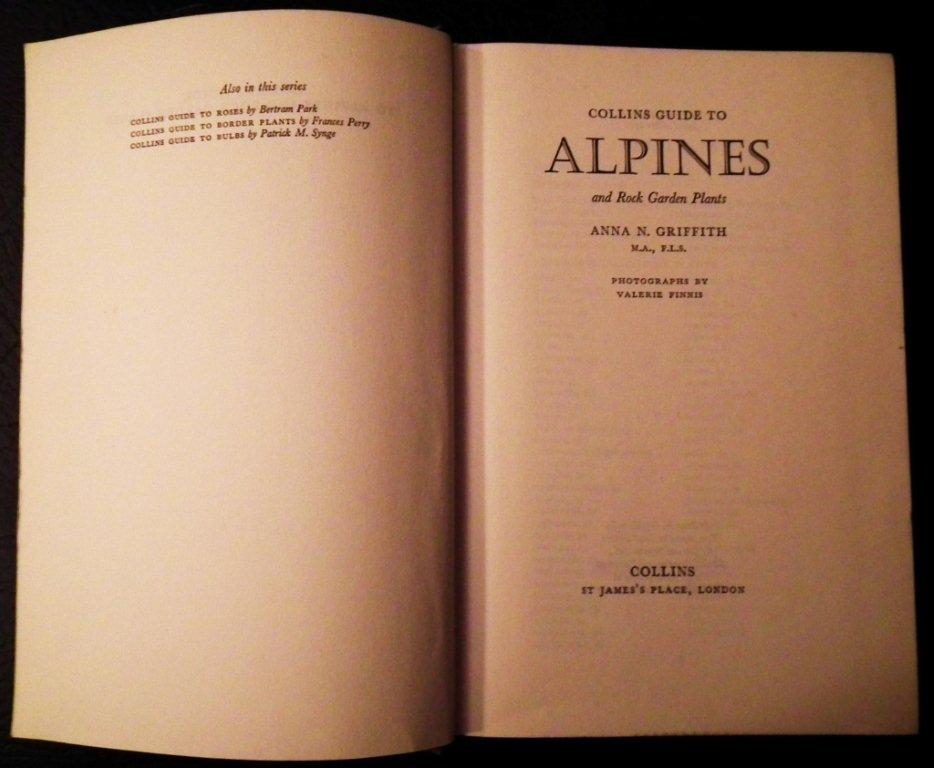
Lots of people say they would love to garden, but they don't have time, or a big enough garden, or the know-how. Well, the latter is easily acquired from books, and also now from the world wide web, obviously. If you don't feel you have the space, and you are short of time because you must work for your bread as well as run a home and pay for the baby minder, (I'm not going to talk about that weird state of affairs just now), and you think a houseplant or two would bring dust and pests into your house (not necessarily the case but it is a widely-held view), get yourself a little sink or fish box, or make a concrete tub, stand it at your back door, fill it with good well-drained soil and grit, and buy some tiny plants. 'Collins Guide to Alpines' , by Anna N. Griffith, published by Collins London in 1972 is the type of book you need now. It gives the names of rock plants which are not in the main hard to find, tells you the type of soil they like to live in, whether they mind getting too wet or not, and when they will flower. When you find these tiny plants you will fall in love with them. The first year you garden this way, you will buy many so-called tiny plants which will take off and become giants; blame the nursery and move them to a border or give them away, and start again. Research and experience will teach you the names of the plants which will stay small. Seed sellers such as www.chilternseeds.co.uk will have seeds of many teeny plants which can be sown outside in your little garden. Or you may want to have another box just for seedlings. Eventually, you may want another sink or trough...but you will not have to walk far to tend your garden, and the plants will not have to be cossetted. You have a whole new interest in life as long as you can keep your plants out of reach of the family dog which was supposed to be the size of a Yorkshire terrier but is daily showing more resemblance to a St. Bernard. You may have to dissuade the family cat from sunning herself on the more cushiony plants, but a few sprinkles of water should do the trick. The library should have books on sink and trough gardening; rock gardening in the title is not always a good bet, as some people have monstrous sized rock gardens with five foot shrubs in them and rocks like the foothills of mountains. Books on trough gardening, though, unmistakeably deal with tiny plants which can be relied upon to stay within the stated limits. And if you ever want to garden in a larger way, all you learn in taking care of your miniature plants will easily transfer to their bigger brethern. Go for it!

'Teach Yourself To Learn A Language' is one of the famous Teach Yourself books, in this case written by P.J.T. Glendening, and published by The English Universities Press Ltd., London in 1963. Inside you will find sensible instructions on what you must do before you proceed to study your language of choice. It gives examples of the type of survey of a language which should be made before you start. The languages surveyed for this purpose are Arabic, Chinese, French, German, Hindustani, Italian, Japanese, Malay, Portuguese, Russian and Spanish. I have found it a wonderful book, which inspires you with confidence in your ability to learn a language.

Irish people have the idea that they are bad at languages. Partly to blame for this is the poor teaching of their own native tongue, well, nowadays, their second native tongue, for we are almost all accomplished speakers of our first language, Hiberno-English. I recall a mature student in UCD telling me that she had just discovered that Irish had genders, Masculine and Feminine, the existence of which she was aware in other languages such as French, but no-one had ever mentioned it concerning Irish. I think that is a sin. What kind of language teaching can lead to that ignorance and confusion? There always seems to have been a school of thought in Ireland that we can learn the Irish language in a kind of osmosis because it is lodged somewhere in our Irish brains, just waiting to come out. But the teaching of languages in Ireland generally is a disgrace. The first thing which should be taught in schools is linguistics. I recall two first-year students in UCD whose first tongues were German and Spanish respectively, who had studied linguistics from the age of seven in Germany and Spain. They got Firsts in their first year university courses, while the Irish struggled with this peculiar discipline. Of course they triumphed later in their further language studies, one in Arabic and Hebrew, the other in English and Portuguese. The former was fluent also in English, Norwegian and Italian as well as of course in her native German.

You don't need me to tell you that we now have a high percentage of young people unemployed. The agencies which are delivering re-education such as Information Technology to these young people ignore the acquisition of foreign languages totally. Yet look on any job recruitment site online and key in that you can speak a language such as German, Italian, Russian and so forth, and you will be inundated with job opportunities just waiting to be filled. The fact that many require a degree should be no problem to our highly-educated populace. Try, for example, http://ie.jobrapido.com/ and put any language in the search box, and give your e-mail address. Day after day you will receive notice of jobs in Dublin or countrywide which are waiting to be filled by anyone who can speak just one foreign tongue. Any government worth its salt should be offering retraining in languages to the young unemployed, even if they only hope to export them to Europe, of which we are supposed to be so much a part. Pshaw! That's what I say. It's time to get real here! You too can learn a language. It's a set of rules which you learn to follow, and a vocabulary which you will acquire if you dedicate yourself to it. Every day people learn new words; the fact that these new words are not English, should make no difference. You can do it!