Showing posts with label gardening. Show all posts

Sunday, 15 April 2012

Green Hope


The sun is shining and the sky is blue; the first swallows have arrived and the world is, as Verga said, green with hope. These are the things of life that are real. There are books which go well with this new world, this mother universe outside the artificiality of economic systems; any attempt to grab and stash the fruits of these works results in empty fists. These are the writings which convert words miraculously into joys, joys far more concrete than the flimsy solids of the materialistic world.

One of the great free joys is to learn even a little of a new language. In that way you can visit the hearts, minds and spirits of another nation without any of the hassle which is part of physically going there. That is how I found Giovanni Verga's short story 'Pane Nero', with the words which enhance my thoughts now that spring is here: “La primavera cominciava a spuntare dappertutto, nelle siepi di fichidindia, nelle macchie della viottola, fra i sassi sul tetto dei casolari, verde come la speranza;.... “ The story is in 'Tutte le novelle' Volume Primo (Part One), and my copy was published in 1996 by Anoldo Mondadori Editore in Milan. I am not fluent in Italian, but I have managed to read and embrace those words.


Herbs For Health And Cookery' by Claire Loewenfeld and Philippa Back, published by Pan Books Ltd. London, in 1965, is a book I have owned for a long time. It is a book about the goodness of herbs, and how to use them both in cooking and in healing. The herbs are described and then recipes for using them in salads, herbal teas, washes and compresses are given in plenty. Above is the recipe for Cheese Soufflé and a Bread and Cheese Pie.

 While I have the cookery books open, I found a great recipe in the Amish Country Cookbook, Volume 1, which was published by Bethel Publishing, Elkhart, Indiana, U.S.A., and edited by Bob and Sue Miller. The book consists of pages and pages of recipes submitted by Amish cooks and gathered by Das Dutchman Essenhaus. This book is a truly wonderful resource, rescued from the recycling centre.                                                                


“ Cocoa Drop Cookies (Unbaked)

Boil together 5 minutes:

2 c. (cups) white sugar
1/2 c. cocoa
1/2 c. milk
1/2 c. butter
1 t. (teaspoon) vanilla

Mix well with 3 c. Quick oats. Drop by spoonfuls on waxed paper and cool.

(Edna Mae Schmucker (Dishwasher)

Now that isn't going to take up too much time to make for your brood. The names of the contributors and their vocations are almost as fascinating as the recipes themselves.

I mentioned before that gardening is one of the joys of my life. It doesn't really matter which gardening book you take up at this time of the year, almost any one will feed your habit while it's dark outside. Royton E. Heath wrote “Miniature Rock Gardening in troughs and pans”, published by W.H. & L. Collingridge Ltd. London in 1957. If you grow any of the plants he recommends in this you can be sure they will be very small. Even more wonderfully, he shows you how to construct the troughs in which to grow them. Having said this, I myself use a miscellany of old fish boxes, very large tubs and old sinks to grow mine. These miniature plants are magic. The other day I found myself gazing in wonder at Anemone lippiensis, which lives underground for a large part of the year. It had emerged in a matter of days, little golden-yellow bowls smaller than the tip of your little finger, lying on green lacy beds of leaves; they are for all the world like miniature peonies. One whole garden of treasures like these can be sited just outside a back door, to be enjoyed no matter what the weather, and every day something new appears.

Growing fruit is something you can do for almost nothing too. The best way may be to find a good variety of apple or pear in a nursery, but you can also grow all kinds of fruit plants from pips and stones, and eventually they will flower and bear fruit. Of course a certain sort of gardener will enjoy telling you that either they will not flower at all, or the fruit they bear, if you should be so lucky, will not be up to much. A week ago I looked at a tub where I am growing a red-leaved apple tree, grown from a pip on a whim about seven years ago, and I saw to my excitement that it has little clusters of buds. It wasn't a question of patience, for there is always too much going on in a garden to sit around waiting for things to happen; those seven or so years have flown, and now my little tree is about to flower. What joy! If you want to read a very good and easy to read book on growing fruit trees, “Growing Fruit” by Roy Genders is one of the very best. Roy Genders is a name to look out for no matter what the garden subject, by the way. This book is in The World Of The Garden series, edited by Alan Gemmell, and I see now that it is actually a Teach Yourself Book by Hodder and Stoughton, published in 1979, which I hadn't noticed before, since I bought it at a school sale many years ago.

Collins Tree Guide, published by HarperColllins in 2004, written by Owen Johnson and illustrated by David More, will lead you to another source of happiness. We are surrounded by trees, but many of us do not know their names, except perhaps the commonest, such as Oak, Sycamore, Holly...it adds to the pleasure of walking in the countryside to know the names of its trees, those creatures great and small without which all life on earth would be unsustainable, and who give to us every living breath we take. It seems a courtesy after that to learn what they are called.

How about a little book just to look through, to calm the spirits, to enjoy just for itself? 'Japanese Style', by Suzanne Slesin, Stafford Cliff, and Daniel Rozensztroch, with photographs by Gilles De Chabaneix, published by Clarkson Potter/Publishers, New York 1994, is a small, colourful book of pictures from Japan, showing Japanese style indoors and out. I don't know why this little work, showing empty rooms and snatches of courtyards should be calming, but it is. Sometimes the pictures are taken through a partly-open door, sometimes they are merely of a hallway or a length of carpet, an open doorway to the outside or a window frame; it reminds me of what you see as a very young child, not knowing for sure what it is, but because you are confined to your cot or seat or wherever until someone deigns to move you, you gaze at the same view, pondering. This too is a magic book. Found with joy at the recycling centre.

From Amazon I bought 'The Haiku Anthology', edited by Cor Van Den Heuvel, and published by W.W. Norton & Co., New York and London, in 1999. On the cover it says ' Over 800 Of The Best English Language Haiku And Related Works' . It is just simply a beautiful book, one to carry with you when you know you are going to have to wait somewhere; it is full of verbal snapshots; the meaning I get from one of these little poems may not be the same as the one you get; it doesn't matter; what I think of the flying swallow I see and what you think of it need not be the same; that is just another joy of life for which there is no payment to be made. The name Haiku has come from the Japanese, and I know these poems are far from their origins. It doesn't matter.


Here are two:

“A plastic rose
rides the old car's antenna -
spring morning”                                             
                                 by Elizabeth Searle Lamb
                                                               

“She's running for office -
for the first time
my neighbour waves.”
                                               by Alexis Rotella


I love them all. Of course, some more than others.

That dear friend I lost last year introduced me to Haiku. Such a gift lasts forever.

Saturday, 24 March 2012

Learning Lessons


Recovering from a surprise bug and unable to do any more than read, (no great penance, needless to say), I found Liam O'Flaherty's 'Famine', which was on my shelves for some time and I always meant to read. I read it in two days and must tell you, it is an amazing, a stunning, a riveting piece of work. There are so many parts of it I would like to tell you about, but they are too many, and I really don't want to spoil the discovery for anyone who gives it a go. I urge anyone who wants a meaningful novel to read, get this book. It is a story told against the background of the Irish Famine, also known as The Great Hunger. The Famine was always given a capital letter when written about, and with reason, for it was an event written into all our psyches, albeit some are unaware of it. I would go so far as to say that it may well be at the back of the country's troubles today, for the way the country behaved during the so-called 'boom' which ended catastrophically in 2008 was definitely not the way a population unscarred by massive want or hunger would behave.

Critics who were quoted on the back cover of the book said that Mary was the heroine, and indeed she was, but underneath it all, Brian, her father-in-law, is the most memorable character. All the characters, however, are well-drawn and rounded figures. It is a horror story all the greater because it describes real times in the life of this small island, from which everyone suffered, at the very least psychologically. Most of the suffering though was physical also, living skeletons walked the roads, eating whatever the countryside provided; those who could got away to England or America.

I never can understand the wide spaces of road edges and the fields lying empty of cultivation or stock which one sees when travelling around the Irish countryside. And not too far from our local town, there are paddocks of ragwort seeding themselves everywhere. Years ago there were warning notices in the post office against ragwort and its dangers for horses and other animals. Nowadays, no-one seems to care. Surely with a history such as ours, empty or poisonous fields cry out to heaven. There is no reason for us not to be totally self-sufficient as far as food is concerned with the land and water we have. As global warming, for whatever reason, continues, others will come and show us how to use our fields.

This book about the Famine was all the more real for me because I've been digging into family history recently, and learned that a great great grandmother who died of post-famine fever was carried to Glasnevin cemetery in Dublin on a wheelbarrow by her husband for burial, because no workers would risk going near the body. Another great great grandfather who was a teacher died in Co. Carlow at the time, with his wife and two young children. Everyone was affected in one way or another. This book was written within ninety years of the horror, in 1937, and the copy I have is a paperback edition dated 1979 and published by Wolfhound Press.

Liam O'Flaherty wrote among other novels one called 'The Informer' which was turned into a film by John Ford, who was actually a cousin of his. I would think that 'Famine' would make an awe-inspiring film too, giving plenty of work to extras. The most momentous parts of the book are very visual:
What more can I say! If you can at all, do read this book.

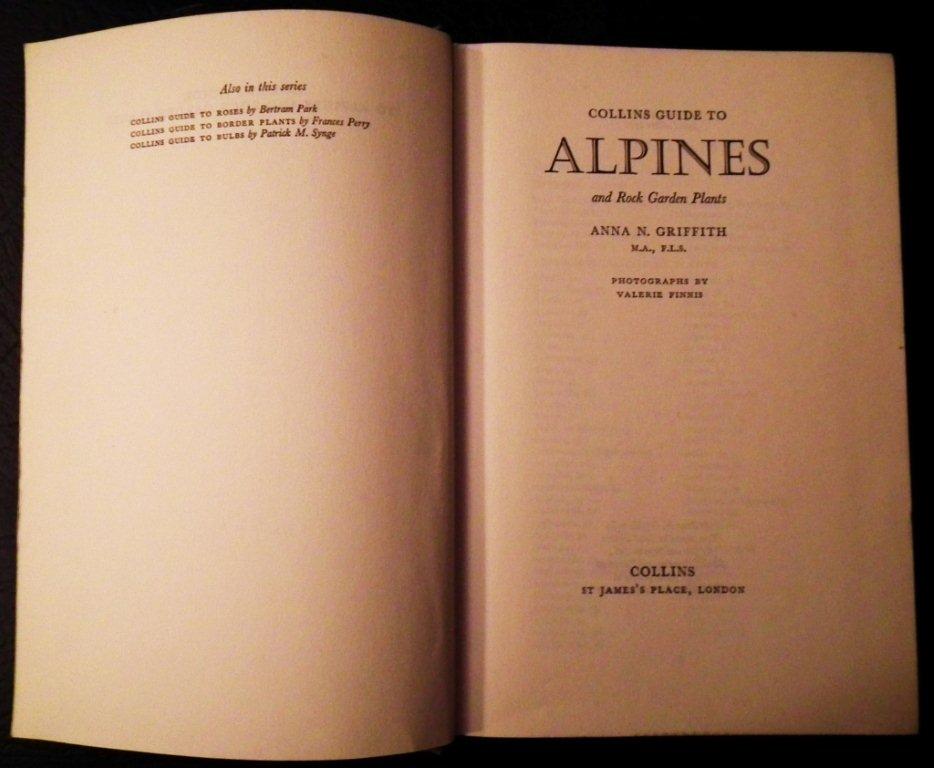
Lots of people say they would love to garden, but they don't have time, or a big enough garden, or the know-how. Well, the latter is easily acquired from books, and also now from the world wide web, obviously. If you don't feel you have the space, and you are short of time because you must work for your bread as well as run a home and pay for the baby minder, (I'm not going to talk about that weird state of affairs just now), and you think a houseplant or two would bring dust and pests into your house (not necessarily the case but it is a widely-held view), get yourself a little sink or fish box, or make a concrete tub, stand it at your back door, fill it with good well-drained soil and grit, and buy some tiny plants. 'Collins Guide to Alpines' , by Anna N. Griffith, published by Collins London in 1972 is the type of book you need now. It gives the names of rock plants which are not in the main hard to find, tells you the type of soil they like to live in, whether they mind getting too wet or not, and when they will flower. When you find these tiny plants you will fall in love with them. The first year you garden this way, you will buy many so-called tiny plants which will take off and become giants; blame the nursery and move them to a border or give them away, and start again. Research and experience will teach you the names of the plants which will stay small. Seed sellers such as www.chilternseeds.co.uk will have seeds of many teeny plants which can be sown outside in your little garden. Or you may want to have another box just for seedlings. Eventually, you may want another sink or trough...but you will not have to walk far to tend your garden, and the plants will not have to be cossetted. You have a whole new interest in life as long as you can keep your plants out of reach of the family dog which was supposed to be the size of a Yorkshire terrier but is daily showing more resemblance to a St. Bernard. You may have to dissuade the family cat from sunning herself on the more cushiony plants, but a few sprinkles of water should do the trick. The library should have books on sink and trough gardening; rock gardening in the title is not always a good bet, as some people have monstrous sized rock gardens with five foot shrubs in them and rocks like the foothills of mountains. Books on trough gardening, though, unmistakeably deal with tiny plants which can be relied upon to stay within the stated limits. And if you ever want to garden in a larger way, all you learn in taking care of your miniature plants will easily transfer to their bigger brethern. Go for it!

'Teach Yourself To Learn A Language' is one of the famous Teach Yourself books, in this case written by P.J.T. Glendening, and published by The English Universities Press Ltd., London in 1963. Inside you will find sensible instructions on what you must do before you proceed to study your language of choice. It gives examples of the type of survey of a language which should be made before you start. The languages surveyed for this purpose are Arabic, Chinese, French, German, Hindustani, Italian, Japanese, Malay, Portuguese, Russian and Spanish. I have found it a wonderful book, which inspires you with confidence in your ability to learn a language.

Irish people have the idea that they are bad at languages. Partly to blame for this is the poor teaching of their own native tongue, well, nowadays, their second native tongue, for we are almost all accomplished speakers of our first language, Hiberno-English. I recall a mature student in UCD telling me that she had just discovered that Irish had genders, Masculine and Feminine, the existence of which she was aware in other languages such as French, but no-one had ever mentioned it concerning Irish. I think that is a sin. What kind of language teaching can lead to that ignorance and confusion? There always seems to have been a school of thought in Ireland that we can learn the Irish language in a kind of osmosis because it is lodged somewhere in our Irish brains, just waiting to come out. But the teaching of languages in Ireland generally is a disgrace. The first thing which should be taught in schools is linguistics. I recall two first-year students in UCD whose first tongues were German and Spanish respectively, who had studied linguistics from the age of seven in Germany and Spain. They got Firsts in their first year university courses, while the Irish struggled with this peculiar discipline. Of course they triumphed later in their further language studies, one in Arabic and Hebrew, the other in English and Portuguese. The former was fluent also in English, Norwegian and Italian as well as of course in her native German.

You don't need me to tell you that we now have a high percentage of young people unemployed. The agencies which are delivering re-education such as Information Technology to these young people ignore the acquisition of foreign languages totally. Yet look on any job recruitment site online and key in that you can speak a language such as German, Italian, Russian and so forth, and you will be inundated with job opportunities just waiting to be filled. The fact that many require a degree should be no problem to our highly-educated populace. Try, for example, http://ie.jobrapido.com/ and put any language in the search box, and give your e-mail address. Day after day you will receive notice of jobs in Dublin or countrywide which are waiting to be filled by anyone who can speak just one foreign tongue. Any government worth its salt should be offering retraining in languages to the young unemployed, even if they only hope to export them to Europe, of which we are supposed to be so much a part. Pshaw! That's what I say. It's time to get real here! You too can learn a language. It's a set of rules which you learn to follow, and a vocabulary which you will acquire if you dedicate yourself to it. Every day people learn new words; the fact that these new words are not English, should make no difference. You can do it!