Saturday, 24 March 2012

Learning Lessons


Recovering from a surprise bug and unable to do any more than read, (no great penance, needless to say), I found Liam O'Flaherty's 'Famine', which was on my shelves for some time and I always meant to read. I read it in two days and must tell you, it is an amazing, a stunning, a riveting piece of work. There are so many parts of it I would like to tell you about, but they are too many, and I really don't want to spoil the discovery for anyone who gives it a go. I urge anyone who wants a meaningful novel to read, get this book. It is a story told against the background of the Irish Famine, also known as The Great Hunger. The Famine was always given a capital letter when written about, and with reason, for it was an event written into all our psyches, albeit some are unaware of it. I would go so far as to say that it may well be at the back of the country's troubles today, for the way the country behaved during the so-called 'boom' which ended catastrophically in 2008 was definitely not the way a population unscarred by massive want or hunger would behave.

Critics who were quoted on the back cover of the book said that Mary was the heroine, and indeed she was, but underneath it all, Brian, her father-in-law, is the most memorable character. All the characters, however, are well-drawn and rounded figures. It is a horror story all the greater because it describes real times in the life of this small island, from which everyone suffered, at the very least psychologically. Most of the suffering though was physical also, living skeletons walked the roads, eating whatever the countryside provided; those who could got away to England or America.

I never can understand the wide spaces of road edges and the fields lying empty of cultivation or stock which one sees when travelling around the Irish countryside. And not too far from our local town, there are paddocks of ragwort seeding themselves everywhere. Years ago there were warning notices in the post office against ragwort and its dangers for horses and other animals. Nowadays, no-one seems to care. Surely with a history such as ours, empty or poisonous fields cry out to heaven. There is no reason for us not to be totally self-sufficient as far as food is concerned with the land and water we have. As global warming, for whatever reason, continues, others will come and show us how to use our fields.

This book about the Famine was all the more real for me because I've been digging into family history recently, and learned that a great great grandmother who died of post-famine fever was carried to Glasnevin cemetery in Dublin on a wheelbarrow by her husband for burial, because no workers would risk going near the body. Another great great grandfather who was a teacher died in Co. Carlow at the time, with his wife and two young children. Everyone was affected in one way or another. This book was written within ninety years of the horror, in 1937, and the copy I have is a paperback edition dated 1979 and published by Wolfhound Press.

Liam O'Flaherty wrote among other novels one called 'The Informer' which was turned into a film by John Ford, who was actually a cousin of his. I would think that 'Famine' would make an awe-inspiring film too, giving plenty of work to extras. The most momentous parts of the book are very visual:
What more can I say! If you can at all, do read this book.
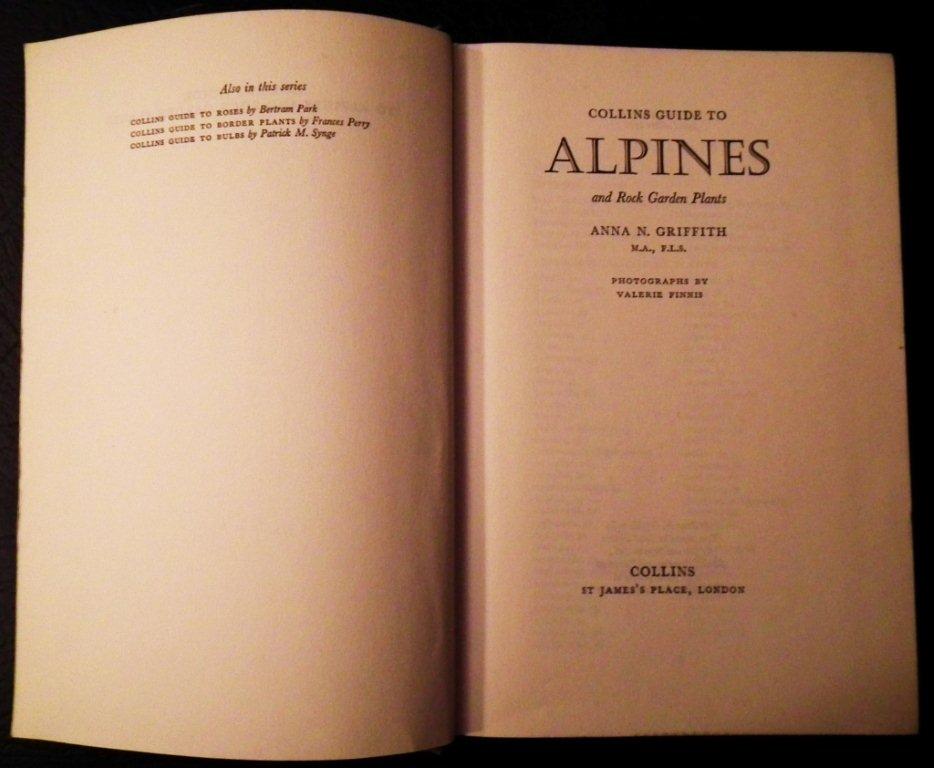
Lots of people say they would love to garden, but they don't have time, or a big enough garden, or the know-how. Well, the latter is easily acquired from books, and also now from the world wide web, obviously. If you don't feel you have the space, and you are short of time because you must work for your bread as well as run a home and pay for the baby minder, (I'm not going to talk about that weird state of affairs just now), and you think a houseplant or two would bring dust and pests into your house (not necessarily the case but it is a widely-held view), get yourself a little sink or fish box, or make a concrete tub, stand it at your back door, fill it with good well-drained soil and grit, and buy some tiny plants. 'Collins Guide to Alpines' , by Anna N. Griffith, published by Collins London in 1972 is the type of book you need now. It gives the names of rock plants which are not in the main hard to find, tells you the type of soil they like to live in, whether they mind getting too wet or not, and when they will flower. When you find these tiny plants you will fall in love with them. The first year you garden this way, you will buy many so-called tiny plants which will take off and become giants; blame the nursery and move them to a border or give them away, and start again. Research and experience will teach you the names of the plants which will stay small. Seed sellers such as www.chilternseeds.co.uk will have seeds of many teeny plants which can be sown outside in your little garden. Or you may want to have another box just for seedlings. Eventually, you may want another sink or trough...but you will not have to walk far to tend your garden, and the plants will not have to be cossetted. You have a whole new interest in life as long as you can keep your plants out of reach of the family dog which was supposed to be the size of a Yorkshire terrier but is daily showing more resemblance to a St. Bernard. You may have to dissuade the family cat from sunning herself on the more cushiony plants, but a few sprinkles of water should do the trick. The library should have books on sink and trough gardening; rock gardening in the title is not always a good bet, as some people have monstrous sized rock gardens with five foot shrubs in them and rocks like the foothills of mountains. Books on trough gardening, though, unmistakeably deal with tiny plants which can be relied upon to stay within the stated limits. And if you ever want to garden in a larger way, all you learn in taking care of your miniature plants will easily transfer to their bigger brethern. Go for it!

'Teach Yourself To Learn A Language' is one of the famous Teach Yourself books, in this case written by P.J.T. Glendening, and published by The English Universities Press Ltd., London in 1963. Inside you will find sensible instructions on what you must do before you proceed to study your language of choice. It gives examples of the type of survey of a language which should be made before you start. The languages surveyed for this purpose are Arabic, Chinese, French, German, Hindustani, Italian, Japanese, Malay, Portuguese, Russian and Spanish. I have found it a wonderful book, which inspires you with confidence in your ability to learn a language.

Irish people have the idea that they are bad at languages. Partly to blame for this is the poor teaching of their own native tongue, well, nowadays, their second native tongue, for we are almost all accomplished speakers of our first language, Hiberno-English. I recall a mature student in UCD telling me that she had just discovered that Irish had genders, Masculine and Feminine, the existence of which she was aware in other languages such as French, but no-one had ever mentioned it concerning Irish. I think that is a sin. What kind of language teaching can lead to that ignorance and confusion? There always seems to have been a school of thought in Ireland that we can learn the Irish language in a kind of osmosis because it is lodged somewhere in our Irish brains, just waiting to come out. But the teaching of languages in Ireland generally is a disgrace. The first thing which should be taught in schools is linguistics. I recall two first-year students in UCD whose first tongues were German and Spanish respectively, who had studied linguistics from the age of seven in Germany and Spain. They got Firsts in their first year university courses, while the Irish struggled with this peculiar discipline. Of course they triumphed later in their further language studies, one in Arabic and Hebrew, the other in English and Portuguese. The former was fluent also in English, Norwegian and Italian as well as of course in her native German.

You don't need me to tell you that we now have a high percentage of young people unemployed. The agencies which are delivering re-education such as Information Technology to these young people ignore the acquisition of foreign languages totally. Yet look on any job recruitment site online and key in that you can speak a language such as German, Italian, Russian and so forth, and you will be inundated with job opportunities just waiting to be filled. The fact that many require a degree should be no problem to our highly-educated populace. Try, for example, http://ie.jobrapido.com/ and put any language in the search box, and give your e-mail address. Day after day you will receive notice of jobs in Dublin or countrywide which are waiting to be filled by anyone who can speak just one foreign tongue. Any government worth its salt should be offering retraining in languages to the young unemployed, even if they only hope to export them to Europe, of which we are supposed to be so much a part. Pshaw! That's what I say. It's time to get real here! You too can learn a language. It's a set of rules which you learn to follow, and a vocabulary which you will acquire if you dedicate yourself to it. Every day people learn new words; the fact that these new words are not English, should make no difference. You can do it!

Saturday, 10 March 2012

A Mixed Bag


Tonight I grabbed six books together off a shelf for the blog. The majority of my books are shelved in a vigorous disorder, so these are quite a mixed bag:

The cookery book “Full and Plenty” was written by Maura Laverty and published by the Irish Flour Millers Association. This is an old copy of the second edition, dated 1966. The unusual thing about this cookery book is that it was written by a novelist, and as you read the chapters, this is plain to see. Before every set of recipes comes a story, about love or blighted love, about the sorrows and tragedies in ordinary people's lives.   The chapter entitled “Eggs Cheese and Cereals” tells the story of a loving widowed mother whose daughter married a well-off man, and who went to live with him in England and never contacted home again. Anyway, the story ends with the daughter's return:

' “Wasn't she the foolish poor child,” said my mother, “to cut herself off from everyone when that go-boy of a husband cleared out and left her without a penny?”

“Don't be talking,” said my aunt Julia. “Pride is responsible for many a sorrow. But I think she had every right to warn her mother when she decided to come home. Mary Neelan might have died of the shock.”

“Small fear of it,” my mother retorted. “No one ever died of joy.” Which, of course, is very true. '

You get the flavour of the book now? It's full of lovely, old-fashioned recipes, mostly Irish.

Here is a description of how to make Irish soda bread, by a character in the chapter on bread:
"Pride and happiness dawned like the rising sun in Mrs. Feeney's face. “It's simple,” she explained eagerly. “Just take the full of the little blue jug of milk, as much as you think of flour, a taste of salt and a suspicion of bread soda. And then you mix it – but you don't wet it, if you know what I mean.”

I got my copy at a school sale, but you should be able to find one yourself easily enough. It was hugely popular in Ireland the minute it was published, and is probably one of those books which would sell very well if republished.*

*It has just been pointed out to me that actually Maura Laverty's cookery book has been republished, but in sections corresponding to the chapters in the original editions.  So obviously it would be better to find a secondhand copy!  Thanks to my reader for the tip.

“The Insurrection in Dublin” was written by James Stephens, a writer who also created Mary Makebelieve in his “The Charwoman's Daughter”.  He wrote the work in 1916 at the time of the Easter Rising, and I found this copy, dated 1965, in a secondhand bookshop. It was probably republished because the 50th anniversary of the uprising was approaching.

I will let the first part of the foreword introduce the work:
"The day before the rising was Easter Sunday, and they were crying joyfully in the churches “Christ has risen” . On the following day they were saying in the streets “Ireland has risen”. The luck of the moment was with her. The auguries were good, and, notwithstanding all that has succeeded, I do not believe she must take to the earth again, nor be ever again buried. The pages hereafter were written day by day during the Insurrection that followed Holy Week, and, as a hasty impression of a most singular time, the author allows them to stand without any emendation.

The few chapters which make up this book are not a history of the rising. I knew nothing about the rising. I do not know anything about it now, and it may be years before exact information on the subject is available. What I have written is no more than a statement of what passed in one quarter of our city, and a gathering together of the rumour and tension which for nearly two weeks had to serve the Dublin people in lieu of news. It had to serve many Dublin people in place of bread. “

'Insurrection' is a beautifully-written book, without any wordiness, an unbearable trait in so many history books. I don't know how historians regard Stephens' account, but it is a pleasure to read. I recommend it to anyone interested in this time in the story of Ireland.   Part of its lure is that it is an account of historic events as experienced by a non-political person.  I have read that Stephens, in company with the novelist Liam O'Flaherty, writes in the manner of the great Russian writers.  How much he was influenced by them I do not know, but his style is sparse, to the point and convincing.

“The Grasmere Journals”, edited by Pamela Woof and published by Oxford University Press in 1991, consists of the diaries of Dorothy Wordsworth, the sister of the poet William. Once again, I will let the Introduction by the editor speak for itself:

“There is simply nothing like it anywhere else. This Journal calls out to us directly across almost two hundred years, and its writer and her world come alive. It sometimes moves in little rushes when days can be noted with a staccato speed; it sometimes slows down to linger on a single figure: a beggar woman, a leech-gatherer, a child catching hailstones at a cottage door, a bow-bent postman with his little wooden box at his back, an old seaman with a beard like grey plush; it sometimes slows to linger on a whole scene: a funeral, or children with their mother by a fire, or a lakeshore on a windy day with daffodils, or a man with carts going up a hill and a little girl putting stones behind the wheels. It sometimes almost stops as the ear catches a ticking watch, a page being turned over, and the breathing of the silent reader by the fire; and then it starts off again at a great pace with the planting and mending and baking and washing and reading and writing and walking and talking, all the weather and the work crammed into a little space of words. “

At times I personally found these journals rather 'dark'. A lot of the entries told of illness, cold, toothache. Dorothy was totally devoted to William in a way most brothers would not tolerate these days; she found his marriage very hard to take and didn't mind admitting it. Then there were bright spots, as when they stop at an inn where they had stayed before:

“My heart danced at the sight of its cleanly outside, bright yellow walls, casements overshadowed with jasmine & its low, double gavel-ended front. We were not shewn into the same parlour where Wm & I were, it was a small room with a drawing over the chimney piece which the woman told us had been bought at a sale.”

Ah, so they had sales in those days too, that is a nice, homely touch.

I love Shakespeare's “Macbeth”. I studied it in school and have never tired of it. It has everything of human nature in it, with the added merit of being short, which anybody reading this blog now knows is an important virtue in books for me. The murder scenes, the ominous chanting of the witches, the guilt-ridden nightmares of Lady Macbeth, the neat plot in which Macduff turns out to be a man 'not of woman born', and in which Great Birnham Wood comes to Dunsinane, all combine to make a gem of brilliance unsurpassed, Who could ever forget Macbeth's soliloquoy after the death of his wife! Close your eyes, imagine a Scottish accent:

“Tomorrow, and tomorrow, and tomorrow,
 Creeps in this petty pace from day to day,
 To the last syllable of recorded time;
 And all our yesterdays have lighted fools
 The way to dusty death. Out, out, brief candle!
 Life's but a walking shadow, a poor player
 That struts and frets his hour upon the stage,
 And then is heard no more: it is a tale 
 Told by an idiot, full of sound and fury,
 Signifying nothing.”


The “Dictionary Of Literary Terms” by Coles Editorial Board, part of the series of Coles Notes published by Coles Publishing Company Limited of Canada, is simply a very useful book for students, giving concise meanings for the terms you will find in works of literary criticism, for instance:

“Imagery: The use of figurative language to enrich poetry or prose. Imagery conveys word pictures. Imagery evokes an imaginary, emotional response, as well as providing a vivid, specific description. Compare, for example, - What you are saying is unpleasant for me to hear, - with “These words are razors to my wounded heart” (Shakespeare, Titus Adronicus.).”
I think now we get the picture.

“The Silent Duchess” was written by Dacia Maraini, who, we are told beside her picture on the inside cover of this Flamingo 1993 paperback, “is one of Italy's best-known female writers.” The blurb ends by saying that “The Silent Duchess has been hailed across Europe as a modern masterpiece.” I came across it in a university bookshop in Dublin. At the heart of this work is a stunning mystery, which I do not wish to destroy for anyone who might read it, so I cannot say much more, except to assure you that for that reason alone, it should not be missed. This translation from the Italian is by Dick Kitto and Elspeth Spottiswood. An historical novel, it reads quickly and easily. I would be willing to bet that you will not guess the outcome if you decide to find and read it. It is at times very sad, without, however, dragging the reader down, and it ends in hope, illustrating the tenacity of a human spirit no matter what the odds.

Whatever book you are reading, let it bring you hope and joy.

Sunday, 4 March 2012

A Sturdy Constitution


I found “The Public Speaker's Treasure Chest – A Compendium of Source Material to Make Your Speech Sparkle” by Herbert V. Prochnow, in the recycling centre. It was published in 1959 by A. Thomas & Co., Preston, and is full of jokes, epigrams, and phrases to help make a 'sparkling speech'. There is a section with enough biblical quotations to confound any proselytizer who might come to your halldoor, that is, if you are the type of person who enjoys such engagements. Nowadays the world and his wife are used to public speaking, judging by the numbers who ring in to radio talk shows and discuss just about anything without a seeming tremor of embarrassment. Perhaps that is why someone chucked this book into the recycling centre, where not many clamoured to reclaim it. Here is a joke I found and enjoyed, although perhaps you may not share my amusement, since I am considered to have no sense of humour:

'Heard at the Zoo

A huge elephant and a tiny mouse were in the same cage at the zoo. The elephant was in a particularly ugly and truculent mood. Looking down at the mouse with disgust he trumpeted, “You're the puniest, the weakest, the most insignificant thing I've ever seen!” “Well,” piped the mouse in a plaintive squeak, “don't forget, I've been sick.” '

There I also found “Bunreacht na hÉireann – Constitution of Ireland” published in 1990 by Irish Government Publications, nestling companionably beside an Irish Labour Party publication of James Connolly's “Socialism Made Easy”. Perhaps some socialist has passed on to a more just world, or someone has followed a political disagreement by disavowing all connections with his/her former comrades, Whatever, I brought them home. I think everyone should have a copy of the Constitution, and I will be able to give this to someone who hasn't. James Connolly's little book, published first in 1909, I would keep if only for the fact that he was so ignobly shot while crippled and unable to stand, following the Easter Rising of 1916. It is very well-written, in concise and persuasive English. I know where I stand on such things, I believe all should have a reasonable amount of land for themselves and their family, to do with as they think best provided that it is used and not left as a danger to health. I do not believe that large tracts of land should be allowed to be in the hands of just a few, and passed on down through generations of their families, to be used for their own personal gain. Mine is quite a simple outlook, simplistic, I know some would say. But there is one belief of mine that I never see in books on economics or anywhere else, unless I am reading the wrong books: I do not believe in the charging of interest on money loaned. I believe it is at the bottom of all financial troubles, and that it is morally wrong. However, very few ever mention this, but take it as a law of Nature that interest should be charged on loans. It is a dreadful evil which exists almost without question in the western world. Anyway, here is a quote from Connolly's little book:

“.....the question to be settled by Socialism is the effect of private ownership of the means of production upon the well-being of the race;........Personally I am opposed to any system wherein the capitalist is more powerful than God Almighty........No worker is compelled to enter a church and to serve God; every worker is compelled to enter the employment of a capitalist and serve him.”

I could not possibly give you Connolly's ideas in one small review, nor would I want to. If you are interested, please find his book for yourself. But to most of us nowadays, these are truths and are self-evident. But still, not much changes, and the majority of workers are still counted among the poor, both categories usually being spoken of as interchangeable.....and with good reason.

I found Cyril Connolly's “Enemies of Promise” in a secondhand bookshop, stamped all over in red ink for fear that the reader might return it for resale. This practice always mystifies me, since even if the book is purchased secondhand, if it is well looked after, surely it could just as easily be resold with further profit. I have never read anything by Cyril Connolly, and the first page I opened was sad, I was touched by his words:

“The new school my parents chose for me was on the coast. At first I was miserable there and cried night after night.My mother cried too at sending me, and I have often wondered if that incubator of persecution mania, the English private school, is worth the money that is spent on it or the tears its pupils shed. At an early age small boys are subjected to brutal partings and long separations which undermine their love for their parents before the natural period of conflict and are encouraged to look down on them without knowing why......I have never met anybody yet who could say he had been happy there. It can only be that our parents are determined to get rid of us!”

I realise that children in England or Ireland rarely are sent to these schools now, but I have often wondered what the difference between them and orphanages could be. I speak as one who actually disapproves of most forms of schooling, and who believes that we should keep our children about us and educate them ourselves, as the law allows us to do. Particularly in these days of internet, there should be no need to farm our children out to the care of others. Of course that would not suit those who need women to work outside the home for wages far below those paid to men, as is still generally the case, according to research published in the last few days. I'm sure you will be able to find it for yourself if you search online. Now here is a link to just one of many websites which you will be able to use to home-educate your children if you so desire. For literacy and language, they need only simply read books: http://www.khanacademy.org/ will take care of all other subjects. You will save money on school textbooks, school uniform, shoes, and school transport, there will be no need to ferry them to and from school, and you will not need to pay an au-pair or housekeeper to look after them. This could save your sanity and your marriage.

“How to be a Nigerian” is another little book from the recycling centre, written by Peter Enahoro, a journalist in Lagos, and published by The Daily Times of Nigeria Limited 1966. It is written in a light-hearted way, and from it I learned, guess what, that Nigerians are just like the rest of us, except for one thing, tribalism. Nigeria, Enahoro explains, was a country invented by Europeans for their own use and benefit, but it is actually an area in which live a large number of tribes, and all the members of each individual tribe unite for the good of their own people. He says:

“The Nigerian society is strictly organised into a variety of tribes. So consuming is the devotion to tribe that if St. Peter were a Nigerian, four-fifths of us would be wasting our time in church and Heaven would soon spill out The Gatekeeper's tribal group of Nigerians. Tribes transcend individuality.” When a Nigerian names a certain person as being a member of a certain tribe....”the reference to his tribe already points to the kind of man he is certain to be. The gentleman in question may never be known by name throughout the conversation, but the fact that he is Yoruba, or Ibo, or Efik is sufficient to identify him.” I cannot say personally if this is all true, but if so, I presume Enahoro is talking about types rather than actual personalities, as it has a racist ring to it otherwise. Other than this assertion about tribalism, it seems to me that there is no difference between ourselves in Ireland and people in Nigeria. Some of the drivers are terrible, some of the customer service people are rude, some who work in service industries are corrupt, what's new?There does seem to be corruption in government, certainly more overt than in these islands. I suppose there will always be areas in which countries differ to a greater or lesser degree. Personally speaking, I had Nigerian friends years ago, and spent evenings in the Overseas Club in Dublin playing cards with them, and they were genial and funny companions. I often wonder how they fared later in life.

Finally, straight to you from the junkyard:


Have a good week, all!

Saturday, 25 February 2012

How I Read It

Years ago I read a lot of fiction because I travelled long distances daily on public transport and it made the journeys bearable. Most of the books I read then are long forgotten, including their titles. Some however I have read again since, and intend to re-read. I'm afraid I'm hard to please as to fiction, having always preferred non-fiction reading. But some books have become an important part of my life: When I talk about these books, you will see that I am not engaging in literary criticism. I am simply telling you about the books I love and what they mean to me. Neither will I be recounting the stories the works embrace, because you may want to read them for yourselves, without any prior expectations.

My copy of Crime and Punishment, by Feodor Dostoevsky, is one of the Collector's Library volumes I wrote about in an earlier blog. I know tastes differ widely, but really, if you do not read this book, you are missing an experience which no other book could ever give you. If you have read it, I recommend that you do so again. Each time I read it, it seems different. It transcends its translation from Russian and also the many years since it was first published in 1866, to enter the mind and lodge there forever. Obviously I am not the only one who loves it, since it is with justification a very famous work.

In the end, however, it is what you or I make of the books we read that counts. Often I think it would be both interesting and refreshing to hear from people who dislike some famous and universally lauded books. How often have we read that a reviewer hates a book through and through.? It would not be long before such a person found him or herself looking for a job. Yet I have opened umpteen novels, read a few lines and closed them forever. Or I have read the first couple of chapters, thinking they are not too bad, and have soon discovered they have lost their charms.

The Householder”, by Ruth Prawer Jhabvala, published in paperback edition by John Murray , London, is a small book, set in India, which I would recommend anyone to read. It is the story of a serious and self-conscious young man in the first months of his made marriage, his developing love for his young wife, how he comes to terms with his interfering mother, his social life, his job...it is a deceptively simple tale, worth reading again and again. It does what a good novel should, to my mind. It rings true. When I got into it, it made me think. I felt sympathy for the characters. And at the end, I felt I had read something worthwhile. It led me along, and I was always interested enough to follow.

This is another important point when reading. Too often have I read and found the train of thought or the plot so tortuous that it was a pain to follow the story, and in the end I just closed the book. When I was very young I used to feel obliged to finish a book even if I really disliked it, and then one day I just realised “I don't need this”, and afterwards I felt freer when reading. However, that has meant that there is now very little fiction that comes my way which I want to finish, and certainly a minimum which I would reread. There are novels which I quite liked when I was reading them, but still I have never felt the inclination to read them again. Two examples of this are “White Tiger”, by Aravind Adiga, and “The Help”, by Kathryn Stockett, which has just recently been made into a much acclaimed film. They are good reads but I do not want to read them again. On the other hand, I intend to buy for myself “No Longer At Ease”, by Chinua Achebe, which I gave away in a fit of generosity to a friend, and which I found unforgettable. In the first place, it is a really good story. But also it explains so much about the background to corruption in Nigeria and other African countries, which most of us only know through those incessant and by now very predictable and boring missives telling of vast sums of money awaiting us in hidden vaults in mysterious banks worldwide which somehow have found their way there after various coups, murders and whatever you're having yourself. Can there really be people who respond to these e-mails? I recall reading somewhere that if even one person does fall for it, the scam has become worthwhile. I would be amazed if even one person ever responds nowadays. The real scam, I think, is on the poor unfortunates who obviously buy copies of these letters believing that by despatching them they will shortly have their fortunes made. That is probably the only way any money is gleaned by those e-mails now. Of course this book was written well before the internet or world wide web existed, in 1960, but somehow it helps to explain the mindset of those who engage in scams of this kind.

The classic novel “Silas Marner”, by George Eliot, is a good read. Once again it has the virtue of being quite a short book, thus holding the attention well. The story has a nice twist which sadly can never totally surprise again after the first reading, and the style of writing is very old-fashiuoned to a modern reader. It was first published in 1861, and my copy is a Collector's Library one, published in 2005. From my liking for shorter books you may conclude that I could not have read any large tomes such as Leo Tolstoy's War and Peace, or Anna Karenin. On the contrary, many teenage days were spent reading these. “Anna Karenin” was worth reading, but I was too young to understand the feelings which motivated her life choices, and I would not have the energy to read it again now. “War and Peace “ I found wonderful, but I skipped all the war and battle scenes, and I know I would do so again. Likewise with that famous novel by Mikhail Sholokhov, 'And Quiet Flows the Don'. I've never been interested in politics, of which most history seems to be composed, and so the battle scenes in that book I also dispensed with. The one part which stuck in my mind to this day and which made the novel memorable for me was the old father at a time of near famine eating and eating all the family's hardwon stores and getting fatter and fatter through grief when his son was missing. Is it enough, I wonder, to be moved by and find unforgettable just one small part of a novel? Perhaps yes. In the same way, I recall the end of the “Beast in Man”, by Emile Zola, and the terrible and powerful picture conjured up of the troop train loaded with war-going soldiers, heading at speed and driverless towards inevitable disaster.

Wind in the Willows “ is one of my all-time favourite works of fiction. Every time I read it I find something new, which is not bad for quite a short book. I remember so well how much I loved as a child the part where Mole finds his old house at Christmas and also the place where Otter is looking for his lost son, and how well I remember Badger's house when his friends come upon it by chance when lost in the snow of the forest. It was first published in 1908, and my copy is once again a Collector's Library one. Kenneth Grahame, the author, wrote it for his son, I believe, and I was sad to read that his son in later life committed suicide. Knowing that gives a further poignancy to the novel, somehow.

No doubt many will consider my tastes very low brow, but I tend to like simple stories. For me, Aesop's Fables cannot be improved upon, though I was never lucky enough to have learned the original Greek. In the category of short stories that never weary, The Oxford University Press collection “Modern Irish Short Stories” contains some true gems, including Frank O'Connor's very well-known “My Oedipus Complex”, and “Guests of the Nation”, two totally different types of work, and the unforgettable “Exile's Return” by Bryan MacMahon, If you can get hold of this collection, there are a few in it which will help you understand much more where the Irish 'are coming from', as they say in current parlance. .The stories are of the old Ireland, but no matter how far we have come from those days, somewhere in our souls many of the old ways linger. The devastating story “Going into Exile” by Liam O'Flaherty, describing a so-called American wake in the days before Skype or the internet, makes one appreciate the gifts of communication we have today.

James Joyce's “The Dead” is one of the stories in the collection. I can see it is a well-written piece, but I cannot warm to it. In fact, I must confess the same of anything of Joyce's I have tried to read. Ulysses is one of those books that I just didn't want to get through, which will no doubt shock many people of a 'literary' turn of mind. I appreciate that it was something quite new in its day, and it's famous for its stream-of-consciousness type of writing that changed literature for ever. However, it is not for me. As for Finnegan's Wake, I didn't even get through the first page. I recall reading the autobiography of a column writer for the Irish Independent of many years ago, who insisted that the peculiar language used in this work was actually taken from the common cant of the inhabitants of the Dublin Liberties in the nineteenth and early twentieth centuries. I cannot recall his name but if I come across it I will put it in the blog so that those interested can judge for themselves.

Books are like people, really. Some, no matter how clever or good, you will not personally like. In the end, no matter how much critics praise a work of fiction, if it doesn't find a resonance in your heart, let it go, it is not for you. For every reader, there will be some books which achieve this, and which will become more than acquaintances in your life. Count yourself lucky and enjoy them as long as you live.

Saturday, 18 February 2012

Speaking Out


Frederick Bodmer's "The Loom of Language" was first published by Allen & Unwin in 1944. The copy I have is a reprint of the first paperback edition, dated 1996. When I was a young teenager I borrowed this book so often from our local library that I began to feel it was mine; then someone else borrowed it and never returned it. Luckily I found one later in a local bookshop. It has never lost its charms for me. For anyone interested in languages, it is an amazing book. It tells the story of languages from earliest times, and traces how the different ones we have today developed. It discusses language learning, the origins of script and writing systems, artificial languages, everything to do with languages. Here you will find tables translating English into all the common Germanic languages, and separate ones translating English into the more common Romance languages. It is a book to take up again and again. If such a book had been written and handed down from the times of Linear A and Linear B there would be a lot of happy scholars now.

The Dictionary of Languages by Andrew Dalby, which describes itself as "The Definitive Reference To More Than 400 Languages" is another fascinating book. I bought it from Amazon, havng come across a review of it by chance. My copy is a paperback published by A &C Black of London in 2006. It details 400 different languages, giving maps of where they are to be found, their origins and relationships with other languages living or dead, and the number of speakers using them as a first language. As you read you realise what treasures our spoken tongues are, how they enunciate emotions and feelings and ideas, how important it is not to let these go, how they are as important a part of our heritage as any artefacts in museums. The Irish Times today had a small piece on a session at the American Association for the Advancement of Science annual meeting which is underway in Vancouver. At the meeting it was said that the technology of the internet and the social media which use it will be the saviour of dying languages. The importance of all languages was stressed. The Times reported that 'The loss of languages spoken by only a few hundred people may not seem an issue when there are plenty more languages to replace them. Yet languages are a unique repository not just of words but also of cultural identity, linguists stressed'......"Languages become a repository of information on plant and animal species, cultural practices, traditional medicine and much more," said Prof David Harrison of Swarthmore college in Pennsylvania. "Through the digital technologies these languages can talk to the world." he said. And I have to say I think that sounds right to me. Owning and reading language books is a personal experience, but sharing this experience with a large number of other people has only been made possible since the arrival of the internet.

"Contemporary Linguistics – An Introduction" by William O'Grady, Michael Dobrovolsky and Francis Katamba, published by Longman, London & New York in 1996, was a college book from about fourteen years ago. It is one of those hefty books I discussed in an earlier instalment of my blog, having been revised and upgraded a number of times, so that shelves and shelves of the earlier volumes teeter in corners of student bookshops. I read recently that a university bookshop in Dublin had thrown out mountains of this type of textlbook because they couldn't sell them. A terrible waste, and definitely a pointer that the looseleaf type of textbook or some other similar system should be produced, where pages with revisions could be easily inserted, and also, the portions of the book required for certain classes could easily be carried in to college as needed and later returned to their place in the book. In this way a textbook would remain relevant for the duration of a particular course, the purchase of the revised pages being easily and cheaply accomplished when necessary, and the whole could be of value as a secondhand book when an individual student has finished with it. No doubt this would affect greatly the sales of college textbook publishers, who are not in the business for purely altruistic reasons, but when the sheer waste involved in producing these updated textbooks year after year is considered, these days there should be no contest, in my opinion. We just cannot live any longer with the squandering of resources which took place in the so-called boom years. They were really the bust years in the true sense, though we were pitifully unaware of it.

In a sale I found a volume entitled "Webster's Third New International Dictionary and Seven Language Dictionary" which appears to be part of a set published by Encyclopaedia Britannica, Inc., Chicago, in 1981.. The section on languages, entitled "The Britannica World Language Dictionary" gives the grammar, vocabulary, pronunciation and useful phrases for French, German, Italian, Spanish, Swedish and Yiddish. English, the source language, is apparently counted in the seven. The grammar section for each language is short but comprehensive. The best thing about this book is that it includes Yiddish, which I have never come across before in any language book. According to the text "..this is the first time Yiddish words have appeared in dictionary form in Roman characters so that they are understandable to all who read English." There are probably quite a few of these old dictionary parts to be found in sales if you're lucky.

For anybody interested in languages I would like to mention www.freerice.com, which is a website run by the United Nations World Food Program. . When you go on you will find yourself on a page giving English words and asking you to give the correct meaning. Questions to which wrong answers are given are given again, until a right answer is obtained. Every time you get an answer right some rice is donated to poor countries. The donors are the advertisers on the site, it is all explained under 'Rice' on the top menu. On the top right of the box where you find the questions, you can click and find a menu of subjects, including mathematics, art history, from tomorrow Anatomy and most importantly from my point of view, there are vocabulary tests for German, French, Italian and Spanish. I would have been more pleased if there were a section for Russian and Chinese vocabulary, the latter in Pinyin for those of us who have not got around to mastering Chinese characters. It is easy to spend hours on this website, but you won't feel you are wasting time because you are testing your knowledge of languages and at the same time donating rice.

Another website is How To Learn Any Language:
http://how-to-learn-any-language.com/e/mezzofanti/biography/index.html and on the page to which this link leads on that site, you will find the fascinating story of one Cardinal Joseph Caspar Mezzofanti, born 17th September, 1774 at Bologna, who was renowned for his vast knowledge of languages. One thing he and I have in common is that apparently he was not a great traveller, which often puzzles people who seem to think that if you are interested in languages you are of necessity interested in visiting foreign lands. As far as I am concerned this is definitely not the case. Of course in his day they didn't have aeroplanes, however, from my point of view air travel is just one more reason to remain at home.

An Irish site which has a very good section for those interested in learning languages is www.boards.ie, The page link is http://www.boards.ie/vbulletin/forumdisplay.php?f=217 .

There is no shortage of websites for language lovers, but those are my particular favourites. Perhaps if you have a personal favourite, you would be kind enough to put a link to it in the comment box on this blog so we can all try it out.

I have been collecting language books for many years. Some have more merits than others, for instance, there are books which are better at explaining grammar, or at providing the learner with colloquial phrases, and some systems are more suitable for certain types of learner than others, but they all have something of value to offer, and are worth holding on to and passing on to posterity.

Saturday, 11 February 2012

Great Big Books


 I think very large books that are not dictionaries or cookery books are often thought of nowadays as coffee table books. Are all coffee table books very large? I tend to think of books so described as being shiny and new, usually unread, but toning in with the décor of their surroundings in such a way as to make them more ornamental than anything else. Who would want to be the first to put a mark on them? Certainly you can put them out on your coffee table without fear that they will be 'borrowed', because they are much too heavy. I would never have enough coffee tables for all my large books. However, I prefer smaller books, for reasons of portability, ease of reading and holding. I googled the term 'coffee table book' and found that they have certain characteristics in common: they are large, illustrations are of prime importance, text is usually sparse; the paper is high-quality, and finally, they are usually much more expensive than normal books.

The large books I am discussing today don't fulfil all those criteria. Although they are lavishly illustrated, there is a lot of text also. They are definitely for reading as well as for looking at. The first three are in the same series. They are “Vanishing Ireland”, published by Hodder Headline, Dublin, 2006, “Further Chronicles of a Disappearing World” published by Hachette Books, Ireland, 2009, and the most recent one “Recollections of Our Changing Times, also published by Hachette Books, Ireland, 2011.

These all are by photographer James Fennell and writer Turtle Bunbury. They follow the same basic arrangement, personal stories of elderly people in Ireland, with their photos alongside Most of the contributors are surprisingly much older than their images would imply. Their stories are simply fascinating and yet they describe in the main quite ordinary events. The style of writing is easygoing, the photographs are so lifelike that you feel as you read that you really know these people. Most of those within these covers are living in or near their original family home; in their lives they were not adventurers, nor keen travellers. Their lives are the lives of everyday folk, and yet there is something enchanting about them. My husband bought the first book in the series, and flew through it in a day. I bought him the other two for Christmas. If you buy them for yourself, they will definitely be very sought-after in years to come, not alone because they are so enthralling to read but for their value to social historians. In the photographs, besides the amazingly interesting faces of the subjects, you can see their kitchens and living rooms, the old fireplaces, the ranges, the pictures on the walls. Here is Paddy Gleeson, a farmer from East Clare who was born in 1904, talking:

'Once, I was coming to school and I met two fellows leading a three-year-old bullock with horns. On his horns was a placard -'The Land for the People and the Road for the Bullock'. And beneath the bull, they were dragging a man who was after evicting a poor widow woman from her home.' The widow's home had been knocked but 'the local people seen how fast it takes to build a house but they did it faster. She was evicted at ten in the morning and she was inside a house that night they built for her in the day! Timber and galvanised!'

In the second book, Denis Galvin from Kerry, born 1945, responds to an enquiry about his age:

'Stop a minute, if I were hung by a rope since I was in my early fifties, I'd be pretty quare looking by now.'   Well, it doesn't do to give too much away, I suppose.

In the third book in the series, Sam Codd of Wicklow, bonesetter, farmer and horse breeder, born 1926, talks about his cars:

'The first car I had was a Morris Minor and I never had anything else,' he says. 'I used to travel around a lot, as a bonesetter, and I do be in a lot of the old farmer places and all that craic. I had two cars here one time, one for taking the girls out on Sunday and one for everyday'.

As far as I can tell, it was the bones of animals he set, but who knows! He talks about the dances held in farmhouses after the threshing:

'They were great auld craic. I remember one lad, a fecker for doing tricks, who wasn't asked to the dance. So he got a ladder up to the house and threw a grain sack over the chimney and smoked out the people inside. He said “They asked me to the threshing, but they didn't ask me to the dance.” '

These books are indeed too beautiful to risk getting coffee rings on them. And if the surface of a coffee table is not available to someone to rest a mug on, I would imagine that mug rings would be an ever present danger. They are also fairly expensive, almost thirty Euro each where we bought them, but they are worth every cent.

Model and Miniature Railways, edited by Patrtick B. Whitehouse and John Adams, published by the Hamlyn Publishing Group Limited in First New English Library Edition dated 1976, turned up in a church book sale. It is full of photographs of miniature railways running through gardens, houses, countryside. There are tiny trains and ones big enough for children and even adults to sit on. Towards the back of the book are detailed plans of the little engines and carriages. When I saw this book I immediately thought “Sheldon would love this”. I don't know if you have ever watched the American situation comedy “The Big Bang Theory”, but Sheldon Cooper is one of the main characters in it. I never used to watch TV, but one day by chance I watched this, and now I know what it means to be a devoted fan. I watch every episode of it that I can. All the characters in it are wonderful, but most of all I love Sheldon. I saw an interview on Youtube with the actor who portrays him and it is amazing how different the actor is from his character. I think Sheldon probably has a type of Asperger's Syndrome. I find his character totally enthrallling, and the joy of the show is particularly in his relationships with the other characters. One of his many hobbies is model railways. If you get a chance to see this show, do take a look, and you will understand why this book would suit Sheldon. What a pleasure it would be to give it as a gift to him, and get one of his strange, grimacing smiles in return.

Two books by The Diagram Group, both on the subject of games and sports, well justify their size, and could easily sit waiting to be consulted on any kind of table or shelf within reach of the sports pundit or card player. These came from a Christmas sale in the local Community Centre. The first is “Family Fun & Games”, published by Sterling Publishing Co., Inc. New York, dated 1992, and the second is “The Official World Encyclopedia of Sports and Games – The rules, techniques of play and equipment for over 400 sports and 1,000 games”, published by Paddington Press Ltd., New York & London, 1979. Although I am certainly no expert, I would guess that there is hardly a game not catered for in these books; card games of all sorts, parlour games, board games, all the rules for these are here in addition to, in the encyclopedia, the rules and regulations for every sport under the sun. I would say these books would settle many an argument for sporty types, and are worth their weight as reference books alone. They are in lovely condition; gone are the days when people donated torn or stained books to such sales, I am happy to say, and at a Euro each they were definitely a bargain. This is the sale where I heard a prissy seller say “My goodness, I didn't realise so many of the village people read books.” After hearing that, I was quite pleased to find two quite old and rare books, one signed by a rather famous author, in the boxes under her nose, and to realise that she didn't know an antique book when she saw one.

A highly colourful book full of easy to follow text and terrific diagrams and photos is “How Everything In The Home Works and how to take the sting out of repair bills” published by the Reader's Digest Association London 2003, Every machine and piece of home equipment you can think of is included, from electrical machines such as washing machines, kettles, breadmakers, ovens, to wheeled machines such as bicycles, scooters and roller skates. All kinds of cameras, analogue, digital and video cameras are covered, DVD players, CD players and so forth. The emphasis is on maintenance more than repair, the point being that if you understand your device and take care of it you won't need to call the repairman very often if at all. It tells you whether the job is one you can deal with yourself or is one that you should leave to the professional. The beginning chapters deal with safety, masks, goggles, how not to kill yourself, in fact. Reader's Digest books are ones that I think are very much taken for granted; I thought about this especially when I heard that the company might be in some difficulty caused by the financial recession. They are among the most useful books you will ever come across, just think of the Reader's Digest Book of the Car, or their gardening and houseplant volumes. Their digests and books are published in many languages; my sister and I became very competent at reading French in our teens, when our mother bought a boxload of French Reader's Digests at an auction. So it seemed natural that when I found “How Everything in the Home Works” sitting on a shelf in the recycling centre, I would make it mine immediately. It is in lovely condition, with not a single crease on a page, nor even a mark. I can't help wondering why it was discarded. The books to be found at the recycling centre in general call up that question. I don't wait too long for answers, for I'm away home with my new treasures.


Saturday, 4 February 2012

Spoken Lives


Listen to people chatting in a café, the noise of cups, the gasp of a coffee machine making a background rhythm to the rise and fall of the narrative; the gentle murmurs of verbal correspondence soothe and lull, without the necessity of personal input. That for me is the beauty of books in which people tell their personal stories; reading them is like listening at a distance; I'm not involved but am captivated by the language, the naturalness of ordinary people speaking out their lives.

All the better if there are photographs of the speakers., as is the case in two of the books I am writing about tonight. Seeing the faces of the speakers adds depth to the experience.

“Forgotten Voices Of The Great War” is by Max Arthur, in association with the Imperial War Museum, published by Ebury Press London in 2003. It was put together from tape recordings of veterans of the First World War from both sides, describing how they were recruited, their training and their experiences on the Western Front and in the Gallipoli campaign. We have read of these horrendous events many times before; they never fail to shock – the waste, the total destruction, but above all the terrible innocence and ignorance of the recruits of all social groupings in believing that the war would last at best a month or so, at worst, maybe a year. Most signed up at the recruiting centres, but some British were actually recruited at the music halls; others were moved to enlist by the finger pointing poster of Kitchener. Germans described the elation of arriving at the Front in trains and being greeted with adulation and flowers; what shocked me most were the women. Mothers wept with pride as their sons marched away; young women, who didn't have to go to the front themselves, handed out white feathers to those they saw in civilian clothing (even soldiers on leave).

Rifleman Norman Demuth of the London Rifle Brigade says:

“As well as being given white feathers, there was another method of approach. You would see a girl come towards you with a delightful smile all over her face and you would think to yourself, 'My word this is somebody who knows me.' When she got to about five or six paces from you she would suddenly freeze up and walk past you with a look of utter contempt and scorn as if she could have spat. That was far more hurtful than a while feather – it made you curl up completely and there was no replying because she had walked on.”

Now when I read about the women left without men after those war years, I don't feel the same sympathy, even though no doubt not all women were like that. Later, with the draft, it was different....and I know they were different times, but one hopes that people would never be so easily led again. Then into the mind come images of body bags flown in from Iraq....Afghanistan...whence next?

Heinrich Beutow was a German schoolboy in 1914. “My memories are those of a child of course. I was in a small German garrison town in 1914 and I remember very well the tremendous enthusiasm. ....I shall never forget the day when they marched out to the trains. All the soldiers were decorated with flowers, there was no gun which did not show a flower. Even the horses I think were decorated. And of course all the people followed them. Bands playing, flags flying, a terrific sort of overwhelming conviction that Germany now would go into war and win it very quickly.”


Kitty Eckersley, a mill worker in Clayton, near Manchester, described how her young husband joined up: They went to a show at the Palace Theatre: “...when we got there, everything was lovely. Vesta Tilley was on stage. She was beautifully dressed in a lovely gown of either silver or gold. But what we didn't know until we got there was that also on stage were Army officers with tables all set out for recruiting. She introduced those songs, 'We Don't Want To Lose You, But We Think You Ought To Go' and 'Rule Britannia', and all those kind of things. Then she came off the stage and walked all round the audience – up and down, either sides, down the middle – and the young men were getting up and following her. .....I don't quite know what happened but she put her hand on my husband's shoulder – he was on the end seat – and as the men were all following her, he got up and followed her too.” Sounds like mass hypnotism, doesn't it? Followed by what we now know was mass murder.

In “Catching Both Sides of the Wind”, by Anita Jackson, five black pastors in Britain in 1982 speak about their lives. This book was published in.1985 by the British Council of Churches, London, and it turned up on the shelves of the recycling centre in lovely condition. Once again, as in any conversation, some things stick out. It's hard to know what is the truth. I found one of the pastors more frank than the rest. The others all seemed to be trying to convey how much less permissive a society it was in the West Indies than in Britain when they arrived during the 1950s.. In their former homelands, according to a couple of the pastors, the church educated and the people looked up to them, and were quite conservative in their behaviour. Reverend Robinson Milwood, a Methodist Minister in London says

"....let me go back and make clearer what I mean by black values. A black value in family life is that the child leaves his family home only for his own home......The permissiveness in Western culture now means that little value is placed on respect for elders in this country, and this has been the main reason for the gap between the black young and the parent generation....There is a clear-cut hiatus between black adults and youngsters in this country,.....”

Pastor Ira Brooks, a Pentecostal Minister, says:

"In the West Indies there's no such thing as a child being born out of wedlock being unlawful. It was common for a man to cohabit with a woman, and she was his wife. And people didn't see anything wrong with that until different standards made it a disgrace to live like that.” He went on to say that people of his generation in Britain were often fearful that their children would find out what life in the West Indies had really been like.

What is the truth? No doubt, as usual, it is somewhere in between the two poles. As with information gleaned from café conversations, who knows? Sometimes we tell it as we want it to be. Appearances seemed to matter a lot. A brother of mine worked in a factory in London as a young man, and laughed as he told me about some of his fellow West Indian workers, who arrived in suits and with briefcases containing only their sandwiches, changed into working clothes, then did the same in reverse at going-home time. It was important to them that neighbours and relatives believed they were office workers for prestige purposes. In the book,there are pretty bleak stories about the way even black pastors were treated. The police, all the pastors were agreed, were not helpful to the black man. Of course they were talking in the 1980s about thirty years earlier, when they had come to Britain. However, the feeling seemed to be that in the 1980s not much had changed. Sometimes it seems from news reports on TV even now that things haven't changed all that much. Most of the pastors hoped to go home eventually, although as one said, their children being British was a kind of a trap for them, because the children had no desire to go back to their parents' homeland. Landlords exploited them, what is new about that tale? Furnished flats had smelly beds bought secondhand, anything was good enough for black tenants. The Irish shared that experience. Thank goodness for modern tenancy laws. But these are the things you don't read about in history books, and yet they are the stories of people, and surely are more important than events. It seems to me that most history is actually the history of politics and warfare, with anything else incidental. I myself did not realise that oral histories of ordinary people's lives were something fairly recent. Now that I think about it, of course it was the advent of the tape recorder that brought these stories to the fore.

“Dublin Street Life & Lore – An Oral History” was written by Kevin C. Kearns, and published in 1991 by Glendale Publishing Ltd., Dun Laoghaire, Ireland., and I found it at a book sale some years ago. It's full of stories told by elderly people who lived and worked in the city of Dublin from the beginning of the last century. Here are the voices of lamplighters, dockers, postmen, chimney sweeps, pawnbrokers, street dealers, newspaper boys, jarveys, even fortune tellers. Some of the reminiscences are surprising.  This is Lizzy Byrne, Moore Street Dealer, at the time of the book aged 82, talking about the Easter Rising:

“..I remember the Rebellion...1916. I was playing on Henry Street when that happened, beside the Post Office. We didn't know what it was, we were too young. We heard the shouting and people got all excited. They were afraid for their life! We locked ourselves up for nearly a week. You'd be afraid to come out. It was only fighting between two certain crowds, you know. But we let them go on with it and it only lasted for about a week.” That is quite a casual description of the Rising that led to the foundation of the new Irish state.

There was one particularly sad memory, told by Willie Murphy, a docker 79 years old when he speaks in the book. He is describing the 'readings' dockers had to endure every day to have a chance of work. The stevedore stood calling out the names of those who would have work that day, calling his own family and relatives first, and this was the 'reading':

“At readings men had it in their minds that there was something at home wanting on that table. And if they didn't get a job that just put them down in the depths. Heartbreaking. It's true.....you could see the tears in their eyes. And they'd run from one read to another cause there'd be readings for other ships. Like some of them we'd call cross-country runners cause they could run that fast to get to another read. As soon as one reading was over you could see them run...” It doesn't bear thinking about, what it must have been like, how soul-destroying, how crushing on self-esteem. No matter what things are like now in Ireland, they are better than that. Also let's not forget that they are still like that in other countries, something we shouldn't forget when immigrants come to us in hopes of a better life.

There was humour too. This is Mickey Sheridan, a 68 year old Jarvey in 1991, talking about another old Jarvey:

“,,,And one old chap, Barney Doherty., had a big old heavy horse under the cab. It should have been under a plough and not under a cab. He wasn't a smart-going horse. So the fare he had in the cab put his head out and says, “hey, jarvey, will you put on the lashes? I can walk quicker!”. And he'd three articles with him. So Barney opened the door and says, “if you can walk quicker there's the path..and there's your three articles of luggage to keep you from breaking into a gallop!” Oh, they were characters.”

I lost a book friend two days ago, the second in a year. He's been a friend for a long time, but not what you could call a really close, see-every-day kind of friend. When we were in touch, it was usually to do with books, and we could talk about them for hours. We would ring each other if we heard of a book sale; he had a friend who ran a bookshop in Dublin, and if I needed a book I would ring him and he would ring his friend to see if he could track it down. One time I was looking for a really obscure title called “The Confessions of Zeno”, an English translation of Italo Svevo's “La Coscienza di Zeno”. This was in the days before you just looked it up on the computer and bought it online. I had searched and phoned everywhere without success; a few minutes after I rang him, he got back to me in great glee saying that incredibly his friend in the bookshop had actually had that very book in his hands when he called, and in the afternoon he brought it to my house still elated over the coincidence. A major part of Svevo's story is Zeno's efforts to give up smoking. My friend shared that problem with Zeno. In November he told me he was dying and the day before yesterday he did.

In life he was a soldier, and later a fireman. One story he loved to tell was about how, going to the fire station one morning in his uniform and halted at traffic lights, he spotted a car going on fire. Leaping out of the car he grabbed a fire extinguisher and ran over and put the fire out. The astonished driver said to him “My God, you fellows certainly are quick”.   He was funny and clever, a wonderful raconteur and unpublished writer; but above all, he loved books. If there are celestial libraries, I will know where to find my two friends when I make that journey myself. Does that sound strange? I can't help noticing that nature has her reasons, for everything . After we have left our teens and twenties, we are not so fast on our feet any more; younger people beat us at most types of active sports. Even if we are very fit, we were probably fitter when we were younger. It is the same with all animals – the older become slower. There is no longer a need for speed. If this is not true of all people, it certainly is of most. Also at a certain age, we stop reproducing, especially if we are women. Once again, this is a physical part of our lives declining because we have fulfilled that part of our destiny. But right up to the moment we die, we can study, read, absorb information of all sorts. Is this some shortsightedness on the part of nature? I think not. And so let us all, eventually, adjourn to the Great Library.